援
Character Story & Explanation
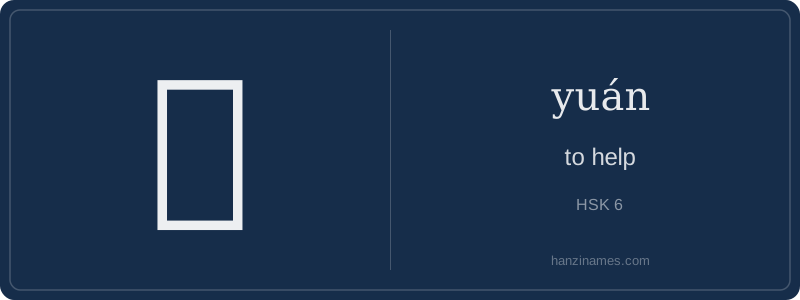
In modern Chinese, 援 appears most frequently in formal, institutional, or literary contexts — rarely in casual speech. It’s central to phrases like 国际援助 (guójì yuánzhù, 'international aid'), 援助灾区 (yuánzhù zāiqū, 'assisting disaster-stricken areas'), and the idiom 援古证今 (yuán gǔ zhèng jīn, 'cite ancient precedents to validate present arguments'). Historically, it featured prominently in Ming-Qing legal codes and Confucian commentaries on benevolent governance. The People’s Republic’s 1950s–60s foreign policy documents routinely used 援 to describe technical and economic cooperation with socialist allies — underscoring its association with sovereign, non-paternalistic support.
The character’s written form has no verified pictographic origin (no oracle bone script attestation exists). Instead, it first appears clearly in Warring States bronze inscriptions as a compound of 扌 and 爰. Today, Chinese students encounter 援 most often in news reports about humanitarian aid or academic essays requiring textual citation — making 援 a quiet marker of civic responsibility and intellectual rigor.
As a linguistic detective, I begin at the scene: the character 援 (yuán) — twelve strokes, radical 扌 (hand), HSK 6. Its structure tells a story of agency: the left side 扌 signals manual action — not passive reception, but deliberate, physical or metaphorical reaching out. The right side, 爰 (yuán), is phonetic but also historically rich: in ancient bronzeware inscriptions, 爰 resembled a hand drawing something upward, suggesting ‘lifting up’ or ‘bringing forth’. This duality — hand + uplift — crystallizes the core semantic: active assistance.
Tracing its evolution through seal script (zhuan shu) and clerical script (li shu), 援 consistently retained its hand radical and phonetic component, resisting simplification. Unlike many characters that lost semantic clarity over time, 援’s form remained remarkably faithful to its meaning: helping isn’t abstract charity — it’s embodied intervention. During the Warring States period, 援 appears in texts like the *Zuo Zhuan* describing military aid — reinforcing that help here implies timely, tangible support, often across boundaries (e.g., one state ‘aiding’ another against invasion).
By the Han dynasty, 援 expanded into moral and intellectual domains: scholars ‘援引’ (yuán yǐn) classical texts — literally ‘drawing up’ quotations as supportive evidence. This usage persists today in academic writing and legal argumentation. Crucially, 援 never connotes pity or condescension; it implies reciprocity, legitimacy, and capacity. Even in modern disaster relief contexts (e.g., ‘国际援助’), the character retains this weight — help as responsible, structured, and dignified action, not mere sympathy.
Example Sentences
Common Compounds
Similar Characters — Don't Mix These Up
Your First Step into Chinese Culture: Get a Chinese Name
Every journey into Chinese begins with a name. Use our free Chinese name generator to create a meaningful, personalized Chinese name that fits you perfectly.
Get My Chinese Name →