搭
Character Story & Explanation
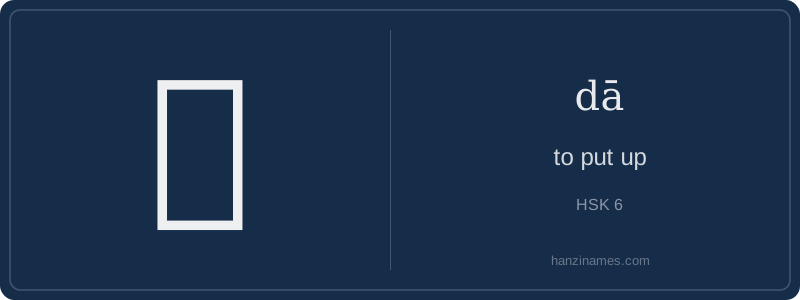
In daily life, 搭 is indispensable for describing practical, hands-on assembly: from students 搭积木 (dā jīmù, building blocks) to engineers 搭脚手架 (dā jiǎoshǒujià, erecting scaffolding). It appears in the HSK 6 idiom 搭配 (dāpèi, ‘to match/coordinate’), reflecting its extension into abstract pairing. Historically, the earliest verified usage comes from the 12th-century *Jiězhì Tōngyào* (‘Essentials of Architectural Practice’), documenting scaffold construction for temple repairs.
The character has no pictographic origin—it’s a phonosemantic compound invented during the late Tang–early Song transition. Instead of ancient imagery, think of a modern scene: a volunteer team at a rural school festival rapidly 搭起一个舞台 (dā qǐ yí gè wǔtái)—‘putting up a stage’ with bamboo poles and tarps before dusk. That urgency, simplicity, and teamwork define 搭.
As a linguistic detective, I begin with the radical 扌—'hand'—which immediately signals physical action. The right side, 答 (dá), originally meant 'to answer' but here functions phonetically, hinting at pronunciation dā while contributing no semantic weight. This is a classic left-radical/right-phonetic (形声字) structure, common in over 80% of modern Chinese characters. Its 12-stroke composition reflects careful balance: three hand strokes on the left, nine strokes forming the phonetic component—each stroke calibrated for legibility and historical consistency.
Tracing its evolution, 搭 appears late in the written record—not in oracle bone or bronze inscriptions—but first reliably in Song dynasty texts (10th–13th c.), where it denoted 'joining materials' like scaffolding or temporary structures. Unlike ancient pictographs, it emerged as a functional compound during vernacular expansion, filling lexical gaps for manual, collaborative construction. Its rise parallels urban growth and architectural innovation in imperial China, where standardized terms for assembling frameworks became essential.
Modern usage retains this core sense of ‘putting up’—but with vital nuance: it implies impermanence, improvisation, or provisional assembly. You don’t 搭 a palace; you 搭 a tent, a stage, or a shelf. This semantic restraint reveals how Chinese characters encode cultural logic: action + temporality + collaboration. Even today, native speakers intuitively reject *搭 a house* (use 建 or 盖 instead), confirming that 搭 isn’t just ‘to put up’—it’s ‘to assemble quickly, accessibly, and without permanence.’
Example Sentences
Common Compounds
Similar Characters — Don't Mix These Up
Your First Step into Chinese Culture: Get a Chinese Name
Every journey into Chinese begins with a name. Use our free Chinese name generator to create a meaningful, personalized Chinese name that fits you perfectly.
Get My Chinese Name →