摧
Character Story & Explanation
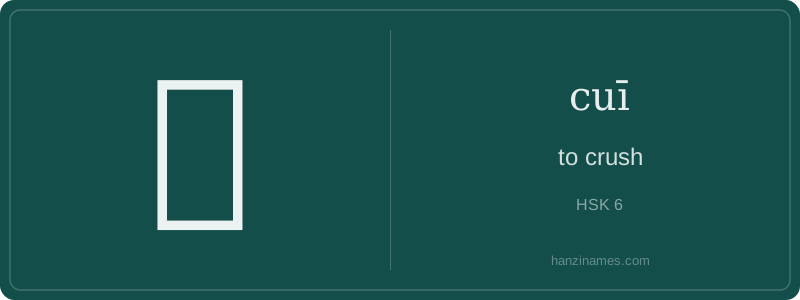
摧 is widely used in modern Chinese media and literature to describe decisive, destructive force — especially in political discourse, historical narratives, and disaster reporting. For example, official Xinhua News Agency headlines use 摧毁 ('to destroy completely') when reporting on missile strikes or anti-corruption campaigns. The idiom 摧枯拉朽 appears in Mao Zedong’s 1949 writings describing the PLA’s rapid victory. It’s also in classical poetry, such as Du Fu’s lines lamenting war’s ruin.
The character’s form dates to seal script (c. 3rd century BCE), where 扌 (hand) + 崔 (a phonetic component meaning 'lofty mountain') visually suggests 'bringing down something towering'. While not a pictograph, its structure reflects ancient conceptual logic: using the hand radical for deliberate human action and 崔 for sound and semantic weight — no oracle-bone origins are attested for this character.
Hi students! Let’s learn 摧 (cuī), a powerful verb meaning 'to break', 'to crush', or 'to destroy' — not gently, but forcefully and often completely. It’s written with the hand radical 扌 on the left, showing it’s an action done by a person or force, and the right side 崔 (cuī) gives pronunciation and hints at height or intensity — like something towering being brought down. This character appears in formal, literary, and dramatic contexts more than everyday chat.
Don’t confuse 摧 with simpler words like 打 (dǎ, 'to hit') or 破 (pò, 'to break' as in 'break open'). 摧 implies overwhelming force — think of a storm demolishing a wall or time eroding a dynasty. It’s used in serious writing: news reports about disasters, historical texts describing fallen empires, and poetic lines about emotional collapse. Its tone is strong and irreversible.
At HSK Level 6, 摧 signals advanced vocabulary mastery. You’ll meet it in idioms like 摧枯拉朽 (cuī kū lā xiǔ — 'crush dry twigs and snap rotten wood'), meaning 'effortlessly defeat'. Since it’s rarely used alone, learning common two-character compounds (e.g., 摧毁, 摧残) is key. Practice writing its 14 strokes slowly — pay attention to the hand radical’s three strokes and the balanced structure of 崔 on the right.
Example Sentences
Common Compounds
Similar Characters — Don't Mix These Up
Your First Step into Chinese Culture: Get a Chinese Name
Every journey into Chinese begins with a name. Use our free Chinese name generator to create a meaningful, personalized Chinese name that fits you perfectly.
Get My Chinese Name →