撒
Character Story & Explanation
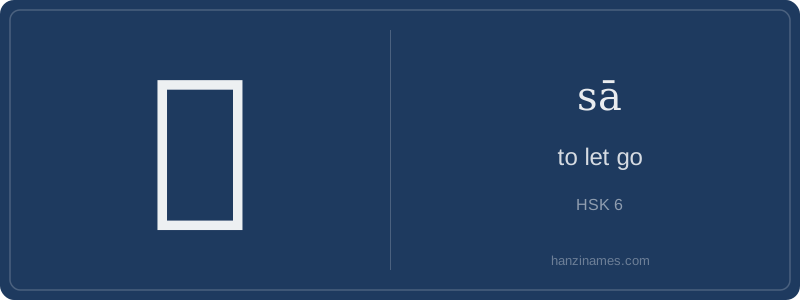
撒 is widely used in modern Mandarin across formal and colloquial registers. It appears in official language (e.g., 撒播社会主义核心价值观 — ‘disseminate socialist core values’), everyday speech (撒娇 sājiāo, ‘to act coquettishly’), and idioms like 撒手人寰 (sāshǒu rénhuán, ‘to pass away’ — literally ‘let go of the mortal world’). Historically, it appears in Song Dynasty texts meaning ‘to scatter’ or ‘to abandon’, and remains unchanged in form since the clerical script era.
The character is a semantic-phonetic compound: left side 扌 (hand radical, indicating action) + right side 散 (sàn, ‘to disperse’, serving as both meaning and sound hint). There’s no oracle-bone origin story — its earliest attested form is in Han-era bamboo slips, consistently representing dispersal or release actions.
Hi students! Let’s learn 撒 (sā), a Level 6 HSK character with 15 strokes and the hand radical 扌 — telling us it involves an action done with the hands. Its core meaning is 'to let go' or 'to release', but don’t think of it as passive — it’s often active, intentional, and physical: letting go of reins, releasing birds, or scattering seeds. It appears in both literal and figurative contexts, so pay attention to tone and context to know whether it means ‘to scatter’, ‘to let loose’, or even ‘to tell a lie’ (in slang).
Notice that 撒 has two standard pronunciations: sā (most common, for actions like scattering or releasing) and sǎ (used only in the fixed phrase 撒播 — sǎbō — meaning ‘to sow’ or ‘to disseminate’, especially ideas or influence). This tone shift is rare but important — never say *sābō*; it’s always *sǎbō*. The character’s structure combines 扌 (hand) + 散 (sàn, ‘to disperse’) — a clear semantic-phonetic compound.
Beginners often confuse 撒 with other hand-related characters like 洒 (sǎ, ‘to sprinkle’) or 拉 (lā, ‘to pull’). Remember: 撒 always implies *releasing outward*, not pulling inward or dripping downward. Practice writing it slowly: start with the 扌 radical (three strokes), then build the right side 散 step-by-step. Use flashcards with real-life examples — like 撒手 (sāshǒu, ‘to let go of one’s hand’, i.e., to give up) — to reinforce meaning through usage, not just memorization.
Example Sentences
Common Compounds
Similar Characters — Don't Mix These Up
Your First Step into Chinese Culture: Get a Chinese Name
Every journey into Chinese begins with a name. Use our free Chinese name generator to create a meaningful, personalized Chinese name that fits you perfectly.
Get My Chinese Name →