扑
Character Story & Explanation
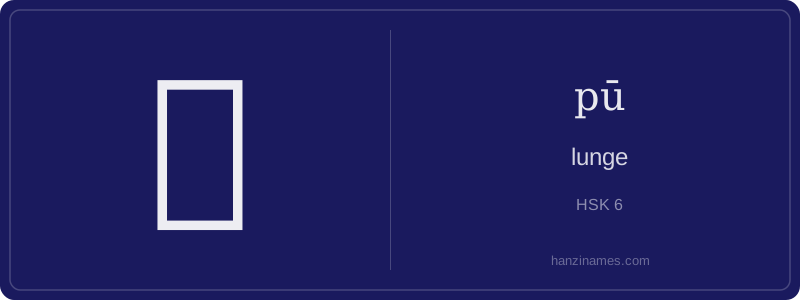
In contemporary Chinese, 扑 is commonly used in compound verbs and idiomatic expressions reflecting urgent physical or emotional action. Key phrases include 扑空 (pū kōng, 'to lunge in vain'), 扑灭 (pū miè, 'to extinguish'—used for fires or rumors), and the literary idiom 扑朔迷离 (pū shuò mí lí, from a Northern Dynasties poem, meaning 'bewilderingly complex'). It also appears in official fire-safety campaigns: '及时扑救初起火灾' ('promptly扑extinguish initial-stage fires').
The character is not pictographic; its earliest attestation is in seal script (c. 3rd century BCE), where the left 扌 clearly denotes hand-related action, and the right 卜 functions purely as a phonetic component (sharing historical sound value with pū). No oracle-bone or bronze-inscription form exists—its documented origin lies in standardized Qin-era script, not ancient imagery.
Imagine a Beijing subway platform at rush hour: a child suddenly stumbles toward the edge as a train screams into the station. Without hesitation, a passerby lunges forward—arms outstretched, body tilting forward, clothes flapping—‘pū!’—and grabs the child just in time. This visceral, full-body motion is precisely what 扑 (pū) captures: not just ‘to扑’, but to hurl oneself headlong into action, driven by urgency or instinct.
Unlike generic verbs like ‘go’ or ‘run’, 扑 emphasizes physical immediacy and directional force—forward, downward, or toward a target. It’s kinetic and dramatic: a firefighter扑ing through smoke, a cat扑ing onto a windowsill, or a journalist扑ing toward a breaking news scene. The character’s three-stroke hand radical (扌) anchors it in human agency, while the right side ‘卜’ (originally a divination symbol, later phonetic) gives pronunciation without softening its impact.
In modern usage, 扑 appears in both literal and metaphorical contexts—often with emotional weight. You might 扑向 hope, 扑进怀中 (throw oneself into someone’s arms), or 扑灭 a fire. Its brevity (just 5 strokes) belies its intensity: every stroke feels like a step in that decisive lunge—first the hand gesture, then the forward thrust, then the impact. It’s Chinese writing’s version of a cinematic jump cut.
Example Sentences
Common Compounds
Similar Characters — Don't Mix These Up
Your First Step into Chinese Culture: Get a Chinese Name
Every journey into Chinese begins with a name. Use our free Chinese name generator to create a meaningful, personalized Chinese name that fits you perfectly.
Get My Chinese Name →