擅
Character Story & Explanation
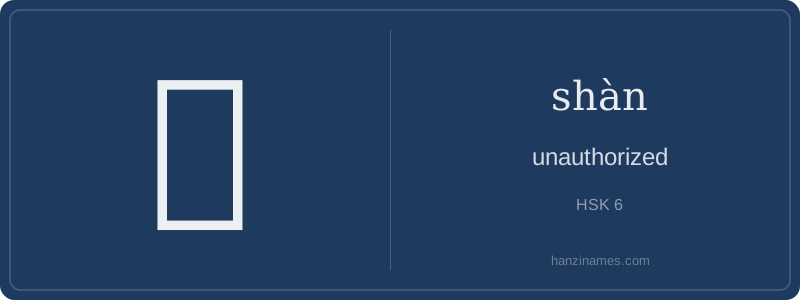
In modern Chinese, 擅 appears frequently in official documents, news reports, and legal discourse to flag procedural violations — e.g., 擅自行动 ('act unilaterally') in military or policy contexts. The idiom 擅离职守 (shàn lí zhí shǒu, 'abandon one’s post without permission') is widely used in workplace regulations and disciplinary notices. Historically, the term appears in Ming and Qing legal codes (e.g., 《大明律》) to describe officials who exceeded mandate, such as levying unauthorized taxes.
The character 擅 is a phono-semantic compound: 扌 (hand radical, indicating action) + 婴 (yīng, phonetic component, though pronunciation diverged over time). Its earliest attested form appears in Han dynasty clerical script, not oracle bones. There is no pictographic origin — it was created as a functional character for administrative precision, reflecting imperial China’s emphasis on regulated official conduct.
The Chinese character 擅 (shàn) carries a nuanced, context-dependent meaning centered on *unauthorized action* — not mere 'skill' as sometimes misrendered. While it can imply competence (e.g., 擅长 shànzhǎng 'to excel at'), its core semantic weight lies in *acting beyond one’s legitimate authority or prescribed role*. This reflects Confucian-influenced social ethics, where proper conduct is defined by position, hierarchy, and ritual propriety (lǐ 礼). Thus, 擅 often appears in legal, administrative, or moral contexts to denote overreach.
In classical and modern usage, 擅 functions primarily as a verb prefix indicating illegitimate agency: 擅动 (shàn dòng, 'to move/act without authorization'), 擅改 (shàn gǎi, 'to alter unilaterally'). It rarely stands alone; instead, it modifies verbs to inject a strong connotation of procedural violation. Unlike English words like 'usurp' or 'overstep', 擅 doesn’t require intent to seize power — even well-meaning but unsanctioned actions qualify (e.g., a doctor prescribing outside protocol).
Western equivalents like 'unauthorized', 'extralegal', or 'ultra vires' come closest — all rooted in formal systems of delegation and jurisdiction. Yet 擅 embeds deeper cultural resonance: it evokes the Confucian ideal of 'doing what is appropriate to one’s station'. A minister who 擅决 (shàn jué, 'makes decisions unilaterally') violates not just rules, but cosmic and social harmony. This contrasts with Western individualism, where initiative is often praised — unless legally prohibited. Hence, 擅 signals ethical boundary-crossing, not just technical noncompliance.
Example Sentences
Common Compounds
Similar Characters — Don't Mix These Up
Your First Step into Chinese Culture: Get a Chinese Name
Every journey into Chinese begins with a name. Use our free Chinese name generator to create a meaningful, personalized Chinese name that fits you perfectly.
Get My Chinese Name →