搁
Character Story & Explanation
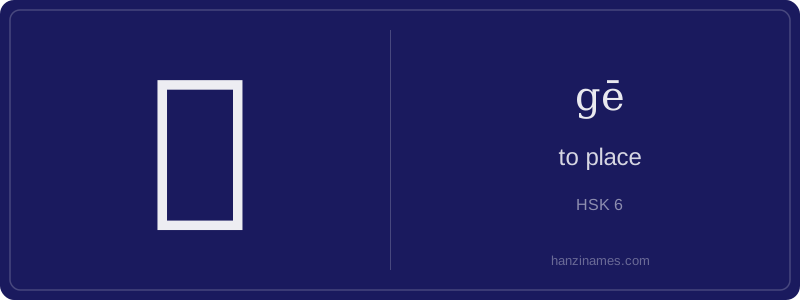
In everyday northern Chinese speech—especially in Beijing, Tianjin, and Hebei—搁 is widely used as a colloquial synonym for ‘put’ or ‘place’, particularly in informal, spoken contexts. It appears in common phrases like 搁哪儿了? (gē nǎr le? — 'Where did you put it?') and the fixed expression 搁不住 (gē bu zhù — 'can’t withstand', e.g., pressure or heat). Historically, it’s documented in Qing dynasty vernacular fiction and early 20th-century Beijing opera scripts as a regional variant of 放, reflecting linguistic diversity in northern Mandarin.
The character is not pictographic; its structure combines 扌 (hand radical) and 阁 (a phonetic component meaning 'pavilion'). While 阁 doesn’t literally depict a building here, it serves as a sound cue (gé) and subtly reinforces the idea of ‘setting something in a designated space’. Today, Chinese people most commonly use 搁 when placing objects on flat surfaces—desks, counters, shelves—in relaxed, conversational settings.
Imagine stepping into a bustling Beijing hutong courtyard on a crisp autumn morning. An elderly neighbor, Auntie Li, gently gēs her steaming teacup onto a weathered wooden stool beside the grapevine arbor—her wrist motion precise, deliberate. This ‘placing’ isn’t just physical; it’s an act of pause, care, and quiet intentionality. In Mandarin, 搁 (gē) captures that exact moment: setting something down with awareness—not tossing, not dropping, but deliberately positioning.
Unlike generic verbs like 放 (fàng), which means ‘to put’ in broad contexts, 搁 carries subtle regional flavor and pragmatic weight. It’s especially common in Northern dialects and colloquial speech, often implying temporary placement or strategic positioning—like搁下手机 to ‘set aside your phone’ mid-conversation. Its tone (first tone, gē) is firm and level, mirroring the stability of the action itself.
The character’s hand radical (扌) signals bodily action, while the right side, 阁 (gé), originally meant ‘pavilion’ or ‘storied building’—suggesting a place where things are *placed for keeping*. Though modern usage rarely evokes architecture, this etymological echo lingers: when you 搁 something, you’re assigning it a temporary ‘spot’, however small—a shelf, a desk corner, even a mental note. It’s placement with purpose, grounded in gesture and context.
Example Sentences
Common Compounds
Similar Characters — Don't Mix These Up
Your First Step into Chinese Culture: Get a Chinese Name
Every journey into Chinese begins with a name. Use our free Chinese name generator to create a meaningful, personalized Chinese name that fits you perfectly.
Get My Chinese Name →