介
Character Story & Explanation
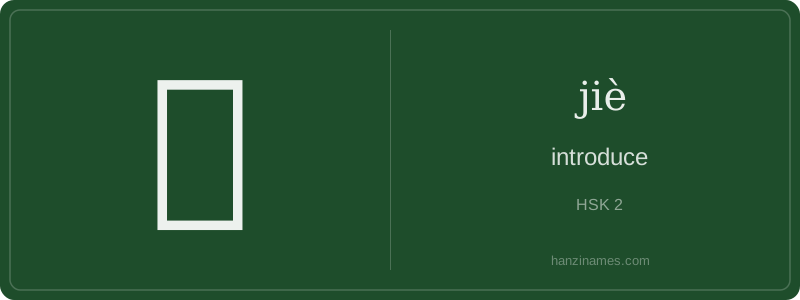
In modern Chinese, 介 is most commonly used in formal or institutional contexts: teachers 'introduce' new topics (介绍新知识), diplomats 'introduce' delegations (介绍代表团), and apps 'introduce' features (功能介绍). It appears in the fixed phrase '不介意' (bù jièyì, 'don’t mind'), where it retains its classical sense of 'interposing oneself'—literally 'not interposing objection'. The idiom '一介书生' (yī jiè shūshēng, 'a mere scholar') uses 介 as a classifier for humble persons, documented since the Tang dynasty.
The character’s earliest attested form appears in Warring States bamboo slips (475–221 BCE) as a symmetrical cross-like shape over a vertical line—interpreted by paleographers as a stylized representation of armor plates (hence original meaning 'to wear armor'). No oracle bone inscriptions contain 介; its earliest secure form is in bronze script, where it clearly denotes protective covering—and by extension, mediation or introduction as an act of 'shielding' or 'facilitating safe passage' between parties.
Our detective begins at the crime scene: the character 介 (jiè), a deceptively simple four-stroke glyph. At first glance, it appears abstract—but its radical 人 (rén, 'person') anchors it firmly in human action. Early seal script forms show two intersecting lines crossing a central vertical stroke, suggesting separation or mediation—like a person standing between two realms. This visual logic foreshadows its core semantic field: introducing, intervening, or serving as a bridge.
Zooming in on historical usage, 介 appears in classical texts like the Zuo Zhuan (c. 4th century BCE) not as 'introduce' in the modern sense, but as 'to wear armor' (a homophone jiè with same graph), later extended metaphorically to mean 'to interpose' or 'to mediate'. Over centuries, phonetic borrowing and semantic broadening shifted its dominant meaning toward 'introducing'—especially in bureaucratic and educational contexts where one person facilitates access to another or to knowledge.
The character’s minimal stroke count (4) belies its conceptual weight: it’s a linguistic hinge. Unlike pictographs depicting concrete objects, 介 is a phono-semantic compound where the sound component (historically linked to 界 jiè, 'boundary') reinforces its function as a liminal marker—someone who stands *between* parties, making introduction possible. Its HSK Level 2 status reflects how early learners encounter it not just as vocabulary, but as a grammatical key in structures like '介于…之间' ('between...and...').
Example Sentences
Common Compounds
Similar Characters — Don't Mix These Up
Your First Step into Chinese Culture: Get a Chinese Name
Every journey into Chinese begins with a name. Use our free Chinese name generator to create a meaningful, personalized Chinese name that fits you perfectly.
Get My Chinese Name →