搅
Character Story & Explanation
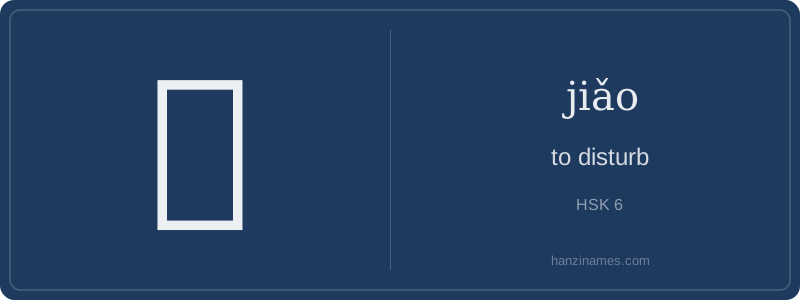
搅 is widely used in modern Mandarin for both concrete and abstract disturbance. Common phrases include 搅局 (jiǎo jú, 'to spoil an event') — frequently cited in news and social commentary when someone disrupts negotiations or public forums. The idiom 搅浑水 (jiǎo húnshuǐ, 'to stir up muddy water') metaphorically means 'to create confusion for personal gain', documented in 20th-century political discourse and still used today. It also appears in culinary instructions: recipes routinely say 搅匀 (jiǎo yún, 'stir evenly').
The character’s form is semantic-phonetic: 扌 (hand radical) + 觉 (jué, phonetic component, though pronunciation shifted to jiǎo). 觉 originally meant 'to awaken' but here serves mainly as sound hint. No oracle-bone or bronze inscription evidence exists for 搅 — it first appeared reliably in Song dynasty texts. Today, Chinese people commonly use it when complaining about noisy neighbors (别搅我 — 'Don’t disturb me!') or describing chaotic group chats (群里又被搅了 — 'The group chat got disrupted again!').
Hi students! Let’s look at the character 搅 (jiǎo). It’s a verb meaning 'to disturb', 'to stir', or 'to interfere' — often with a slightly negative or disruptive connotation. Notice its radical 扌 (hand), which tells us it involves physical action — like using your hand to mix something or disrupt a situation. Though simple in form, it carries rich nuance: stirring soup is neutral; stirring up trouble is not!
This character appears in both literal and figurative contexts. In cooking, 搅拌 (jiǎobàn) means 'to stir-mix'; in social life, 搅局 (jiǎo jú) means 'to spoil an event' — like showing up uninvited and derailing a meeting. Its tone (third tone) is important: jiǎo sounds like 'jow' with a falling-rising pitch. Practice saying it slowly while imagining twisting your wrist — that motion matches the character’s meaning!
At HSK Level 6, 搅 reflects advanced vocabulary use: learners must grasp subtle distinctions between similar verbs like 拌 (bàn, 'to mix gently') or 扰 (rǎo, 'to disturb abstractly'). Unlike 扰, which targets peace or order (e.g., 打扰 dǎrǎo — 'to bother'), 搅 emphasizes *active, hands-on disruption* — whether of liquids, plans, or emotions. Mastering it helps you express complexity in Chinese expression.
Example Sentences
Common Compounds
Similar Characters — Don't Mix These Up
Your First Step into Chinese Culture: Get a Chinese Name
Every journey into Chinese begins with a name. Use our free Chinese name generator to create a meaningful, personalized Chinese name that fits you perfectly.
Get My Chinese Name →