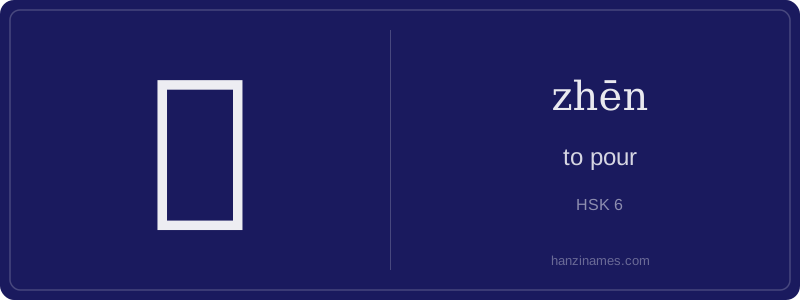
斟
Character Story & Explanation
In modern Chinese, 斟 appears most commonly in the compound 斟酌 (zhēnzhuó), meaning 'to deliberate carefully' — used in formal writing, legal documents, academic papers, and news reports. For example, officials '斟酌政策细节' ('deliberate policy details') before announcing reforms. It also appears in classical poetry and Confucian texts describing ritual wine service during ancestral ceremonies — documented in sources like the Rites of Zhou (c. 3rd century BCE).
The character’s form evolved from seal script, where 斗 clearly resembled a ladle with a handle and bowl. No oracle bone form survives, but bronze inscriptions from the Warring States period show 斗-based characters consistently linked to measurement and pouring. Today, Chinese people use 斟 almost exclusively in compounds — never alone in speech — and almost always in contexts demanding thoughtfulness or formality.
Hi students! Let’s learn 斟 (zhēn), a Level 6 HSK character meaning 'to pour' — especially in careful, ceremonial, or thoughtful contexts. Unlike the everyday verb 倒 (dào), which means 'to pour' casually (like pouring water from a kettle), 斟 carries elegance and intention. Think of a host slowly filling a guest’s wine cup at a formal banquet — that’s 斟. It’s not just movement; it’s respect, attention, and balance.
This character appears mostly in written or formal spoken Chinese — literature, speeches, etiquette guides, and idioms. You’ll rarely hear it in quick chat, but you’ll see it often in phrases like 斟酌 (zhēnzhuó, 'to deliberate'), where the 'pouring' idea metaphorically extends to 'measuring out thoughts carefully', like pouring wine drop by drop.
The radical 斗 (dǒu) is an ancient measuring vessel — a ladle or dipper used for grain or wine. That makes perfect sense: 斟 literally means 'to pour *using a ladle*'. The right side, 甚 (shèn), originally meant 'very' or 'extremely', but here it serves as a phonetic hint (zhēn sounds close to shèn in Old Chinese). So 斟 = 'ladle' + 'sound clue' = intentional, measured pouring.
Example Sentences
Common Compounds
Similar Characters — Don't Mix These Up
Your First Step into Chinese Culture: Get a Chinese Name
Every journey into Chinese begins with a name. Use our free Chinese name generator to create a meaningful, personalized Chinese name that fits you perfectly.
Get My Chinese Name →