旋
Character Story & Explanation
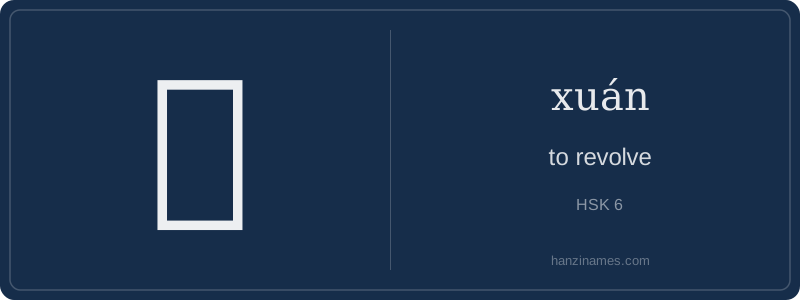
In modern Chinese, 旋 appears frequently in compound words and formal registers: it’s essential in scientific terms (e.g., 旋转 xuánzhuǎn, 'rotation'), idioms (如鸟旋空 rú niǎo xuán kōng, 'like a bird circling the sky'—a phrase from Tang dynasty poetry describing effortless grace), and technical language (e.g., 旋翼 xuán yì, 'rotor blade'). It’s also common in place names (e.g., 旋涡镇 Xuánwō Zhèn, 'Vortex Town' in Jiangsu) and historical military texts referring to tactical maneuvering.
The character’s form originates from the Bronze Script (c. 1200–256 BCE), where it combined 方 (fāng, 'square/direction')—acting phonetically—and 㫃 (yǎn, a banner-like element)—originally suggesting movement with directionality. Later, the component evolved into 丿 + 一 + 丶 in the modern form, retaining its association with directional turning. No oracle-bone inscriptions of 旋 are confirmed; earliest attested uses appear in Warring States bamboo slips describing chariot maneuvers.
The Chinese character 旋 (xuán) fundamentally conveys rotational or cyclical motion—spinning, revolving, or turning around a center. Unlike English verbs like 'spin' or 'rotate', which emphasize mechanical action, 旋 carries poetic and philosophical weight in Chinese, often implying natural rhythm, inevitability, or transient beauty—e.g., in classical poetry describing swirling mist or falling leaves. Its use extends beyond physics into abstract domains: fate, time, and even political shifts ('the whirlwind of change').
Western equivalents like 'whirl', 'vortex', or 'gyre' (as in Yeats’ 'The Second Coming') come closest in evoking both physical motion and metaphysical turbulence—but lack 旋’s grammatical versatility. While English requires auxiliary verbs or nouns to express related concepts (e.g., 'to revolve around an idea'), 旋 functions seamlessly as verb, noun, or modifier, reflecting Chinese’s economy of expression and deep-rooted cosmological view of cyclicality.
This character also embodies the Daoist and Confucian reverence for harmony-in-motion: not chaotic spinning, but purposeful, balanced rotation—like celestial bodies or the turning seasons. In contrast, Western metaphors of revolution (e.g., 'revolutionary change') often imply rupture or progress, whereas 旋 suggests continuity within change. Even its alternate reading xuàn (in dialectal or specialized contexts like 旋风 xuànfēng, 'whirlwind') retains this core semantic field—underscoring how one grapheme can encode layered, context-sensitive meaning across registers.
Example Sentences
Common Compounds
Similar Characters — Don't Mix These Up
Your First Step into Chinese Culture: Get a Chinese Name
Every journey into Chinese begins with a name. Use our free Chinese name generator to create a meaningful, personalized Chinese name that fits you perfectly.
Get My Chinese Name →