昔
Character Story & Explanation
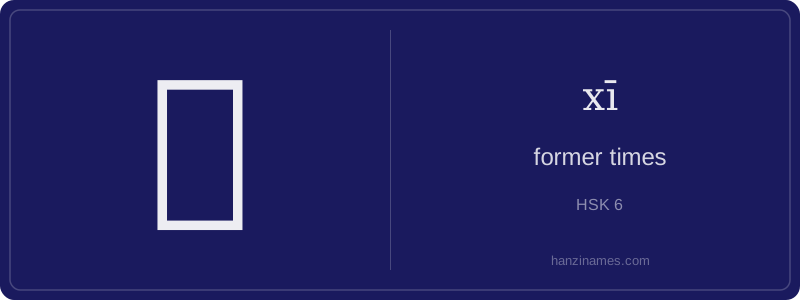
In modern Chinese, 昔 appears almost exclusively in literary, historical, or rhetorical contexts—not in casual speech. It’s central to idioms like 昔日 (xīrì, 'days of yore') and 昔年 (xīnián, 'former years'), both common in news headlines, memoirs, and political speeches referencing past achievements or hardships. The phrase 昔我往矣 (xī wǒ wǎng yǐ), from the *Classic of Poetry*, remains widely quoted in education and cultural discourse as a model of nostalgic diction.
The character’s form is documented in the *Shuōwén Jiězì* as composed of 日 (radical, meaning 'sun/day') on top and a phonetic element below—originally resembling 曰 (yuē) but historically derived from the obsolete phonetic 舊. No oracle bone evidence exists; its earliest attested form is late Warring States (4th c. BCE) bamboo slips, confirming its role in early written historical narrative.
As a linguistic detective, I begin with the oracle bone and bronze inscriptions—but here’s the twist: 昔 doesn’t appear in confirmed Shang oracle bones. Its earliest secure form emerges in Warring States bamboo texts and the *Shuōwén Jiězì* (121 CE), where Xu Shen classifies it under the 日 (sun/day) radical—not as a pictograph of time, but as a phonosemantic compound. The top component 曰 (yuē, 'to say') is now understood to be a corrupted form of 舊 (jiù, 'old'), later simplified to the current shape. This reveals how character forms fossilize historical sound shifts rather than literal images.
The radical 日 anchors 昔 firmly in temporal semantics—'day' as the basic unit of measured time—while the lower part evolved from an ancient phonetic indicator related to *sik* or *sek*, preserved in Middle Chinese /siek/ and modern xī. Unlike purely pictographic characters, 昔 is a product of orthographic streamlining: scribes gradually replaced complex phonetics with simpler, more regular strokes, sacrificing visual transparency for writing efficiency across centuries.
This evolution mirrors China’s bureaucratic needs: as imperial archives expanded, clerks prioritized speed and consistency over etymological fidelity. By the Han dynasty, 昔 was standardized as an elegant, balanced 8-stroke glyph—symmetrical, compact, and easily distinguishable in dense legal or historical texts. Its stability since then underscores its functional success: not a relic of ancient ritual, but a workhorse character for recording chronology, contrast, and reflection—making it indispensable in classical historiography and formal prose.
Example Sentences
Common Compounds
Similar Characters — Don't Mix These Up
Your First Step into Chinese Culture: Get a Chinese Name
Every journey into Chinese begins with a name. Use our free Chinese name generator to create a meaningful, personalized Chinese name that fits you perfectly.
Get My Chinese Name →