昼
Character Story & Explanation
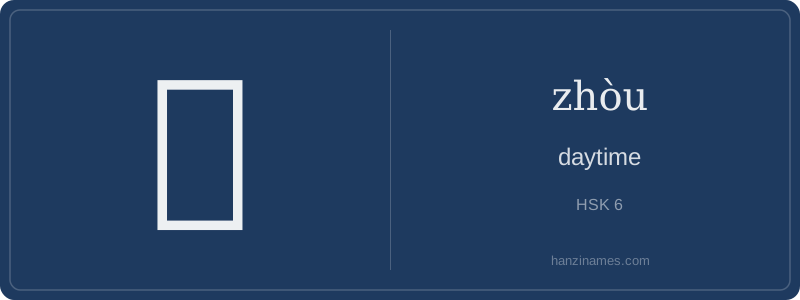
昼 appears in standard Mandarin compound words like 白昼 (báizhòu, 'daylight') and in fixed expressions such as 昼夜不停 (zhòuyè bù tíng, 'day and night without stopping'), widely used in news reports about infrastructure projects or medical emergencies. It’s also in the HSK 6 idiom 昼思夜想 (zhòu sī yè xiǎng, 'think by day, dream by night'), meaning 'to obsessively long for someone or something'. Historically, 昼 was used in imperial almanacs and agricultural calendars to demarcate work hours.
The character’s earliest attested form (in seal script, c. 3rd century BCE) shows 尸 (a crouching figure) over 旦 (dàn, 'dawn', with the sun above the horizon). This composition reflects its semantic core: human activity under daylight—no mythical origin, but a clear functional logograph rooted in agrarian timekeeping.
Imagine walking through Beijing’s Houhai Lake at noon—sunlight glinting off the water, cicadas buzzing fiercely, vendors selling chilled plum juice under red umbrellas. This vibrant, sun-drenched peak of the day is precisely what 昼 (zhòu) captures: not just 'day' in the 24-hour sense, but the warm, active, luminous *daytime*—the hours when life pulses most intensely.
Unlike 日 (rì), which means 'sun' or 'day' broadly (as in 日子 'days of life'), 昼 specifically denotes the sunlit half of the day—roughly from sunrise to sunset, especially the midday period. It carries a quiet poetic weight: classical poets used it to contrast with 夜 (yè, 'night'), evoking rhythm, balance, and the natural cycle central to Chinese cosmology.
In modern usage, 昼 feels slightly formal or literary—rare in casual speech ('What time is lunch?') but common in written contexts: weather reports, historical texts, and idioms like 昼伏夜出 ('day-hiding, night-emerging', describing nocturnal habits). Its radical 尸 (shī)—originally a pictograph of a person crouching—hints at the human posture during daylight activity: upright, engaged, visible.
Example Sentences
Common Compounds
Similar Characters — Don't Mix These Up
Your First Step into Chinese Culture: Get a Chinese Name
Every journey into Chinese begins with a name. Use our free Chinese name generator to create a meaningful, personalized Chinese name that fits you perfectly.
Get My Chinese Name →