晓
Character Story & Explanation
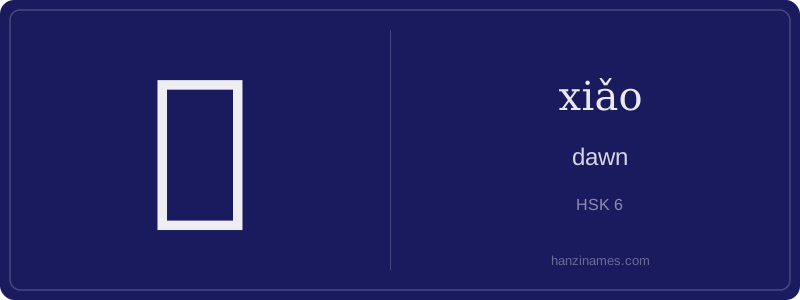
In daily life, 晓 appears in formal contexts like news headlines (‘晨晓时分’), literary titles (e.g., Mo Yan’s short story ‘透明的红萝卜’ references ‘晓光’), and common idioms such as ‘家喻户晓’ (jiā yù hù xiǎo)—‘known in every household’—where 晓 means ‘to know clearly’, reflecting its semantic extension from ‘dawn’ to ‘understanding’. It’s also used in names (e.g., actor Zhao Benshan’s daughter Zhao Yushan’s courtesy name includes 晓) and poetic expressions like ‘破晓’ (pò xiǎo, ‘daybreak’), evoking resilience.
The character first appears in seal script (c. 3rd century BCE), composed of 日 (sun) and 尧 (a phonetic component, later simplified to 口 + 尧’s top). It was never a pictograph of dawn itself, but a phono-semantic compound: 日 signals the solar domain, while 尧 (yáo) provided sound. The modern form retains 日 on the left and a simplified right side (尧 → 口 + 元), preserving both meaning and phonetic trace.
晓 embodies the Chinese philosophical reverence for cyclical renewal—dawn isn’t just a time, but a quiet triumph of light over darkness, symbolizing clarity after confusion and hope after uncertainty. In classical thought, this moment reflects the Daoist ideal of natural harmony: the sun (日) rising without force, revealing truth effortlessly. The character thus carries moral weight—'to understand' (xiǎo) is etymologically linked to 'dawn', suggesting insight arrives like morning light: gradual, inevitable, and illuminating.
Unlike Western metaphors that often frame enlightenment as sudden revelation, 晓 conveys gentle, organic awakening—mirroring Confucian pedagogy where understanding unfolds through reflection and experience. Its radical 日 (sun) grounds it in cosmic rhythm, while the 口 (mouth) component historically signified vocalization of newfound awareness—linking knowledge with articulation and shared wisdom.
This duality—astronomical event and cognitive breakthrough—reveals a core Chinese worldview: time, nature, and human consciousness are interwoven. Dawn is not passive background but an active teacher; to ‘know’ is to align oneself with celestial order. Thus, 晓 appears in texts from the *Zuo Zhuan* to modern literature not merely as chronology, but as a moral and epistemological milestone—marking when ignorance yields to reasoned clarity.
Example Sentences
Common Compounds
Similar Characters — Don't Mix These Up
Your First Step into Chinese Culture: Get a Chinese Name
Every journey into Chinese begins with a name. Use our free Chinese name generator to create a meaningful, personalized Chinese name that fits you perfectly.
Get My Chinese Name →