朽
Character Story & Explanation
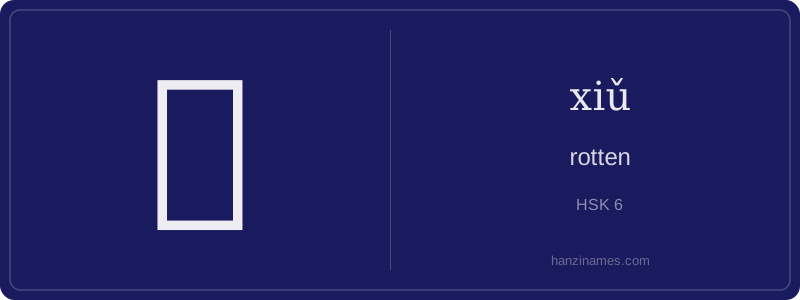
In daily life, 朽 appears most often in fixed expressions like 不朽 (bù xiǔ, 'immortal')—used for enduring legacies (e.g., 不朽功勋, 'immortal contributions')—and 腐朽 (fǔ xiǔ, 'decadent, rotten'), a term historically deployed in CCP political discourse since the 1940s to condemn feudal or bourgeois ideology. The idiom 玉石俱焚, while not containing 朽, reflects its semantic field; more directly, 成语 '朽木不可雕也' ('rotten wood cannot be carved')—from the Analects—remains widely quoted in education and media to criticize incorrigibility.
The character’s form is well-documented: it’s a phono-semantic compound (形声字), with 木 (wood) as the semantic radical indicating material origin, and 右 (yòu, 'right') as the phonetic component (archaic pronunciation close to *l̥uʔ, later shifting to xiǔ). No oracle-bone form survives, but its earliest attestation is in bronze inscriptions of the Warring States period, consistently depicting decayed timber.
The character 朽 (xiǔ) evokes the quiet decay of time—wood warping in a rain-soaked courtyard, lacquer peeling from an antique cabinet in a Suzhou garden, or bamboo scaffolding leaning precariously on an old Shanghai shikumen building. Its six strokes flow from left to right: first the 木 (wood) radical, then the 右 (right) component simplified into 丂 + 一 + 丿—visually echoing collapse, softening, and eventual disintegration. It’s not violent decay, but slow, inevitable surrender to moisture, age, and neglect.
In classical Chinese, 朽 carried moral weight: Confucius said, 'I have not seen one who loves virtue as he loves beauty, nor one who hates rottenness (朽) as he hates bad odor' (Analects 17.23), linking physical decay to ethical decline. The character appears in ritual texts warning against letting talent or virtue ‘rot’ unused—a cultural metaphor still alive in modern Mandarin when criticizing wasted potential or institutional stagnation.
Though rarely used alone today, 朽 thrives in compound words and idioms where it conveys irreversible deterioration—not just of matter, but of reputation, willpower, or ideals. Its presence signals gravity: when someone says a plan is 朽了, it’s not merely outdated—it’s fundamentally unsound, like worm-eaten timber. This layered resonance makes it a high-level HSK 6 marker: mastery requires grasping both its concrete botanical roots and its abstract, almost philosophical, condemnation of entropy.
Example Sentences
Common Compounds
Similar Characters — Don't Mix These Up
Your First Step into Chinese Culture: Get a Chinese Name
Every journey into Chinese begins with a name. Use our free Chinese name generator to create a meaningful, personalized Chinese name that fits you perfectly.
Get My Chinese Name →