杜
Character Story & Explanation
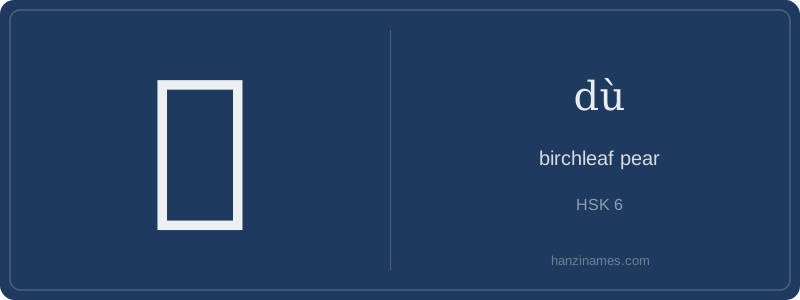
In modern Chinese, 杜 most commonly appears in the surname Dù (e.g., poet Du Fu), and in compounds like 杜绝 (dùjué, 'to eradicate')—a high-frequency term in policy documents and public health campaigns (e.g., '杜绝谣言' — 'eradicate rumors'). It also survives botanically in 杜梨 (dùlí), the wild birchleaf pear, referenced in agricultural manuals and herbal pharmacopeias like the Compendium of Materia Medica (Bencao Gangmu).
The character’s written form has no oracle-bone or bronze-age pictograph. It first appears in seal script (c. 3rd c. BCE) as a phonosemantic compound: 木 (semantic, 'tree') + 土 (phonetic, approximating dù). No archaeological evidence supports a 'door' or 'stop' origin—the 'block/stop' meaning emerged later via semantic extension from 'boundary tree' → 'barrier' → 'to prevent'.
As an archaeologist sifting through bamboo slips from the Han dynasty, I found 杜 etched not as a mere tree name—but as a boundary marker. Its left side 木 (wood/tree) anchors it in botany, while the right side 土 (earth) signals territorial demarcation: ancient states planted杜trees along borders to signify controlled land. This dual role—botanical and geopolitical—emerges clearly in excavated legal texts where '杜界' (dù jiè) meant 'pear-tree boundary line.'
The character’s early bronze inscriptions show no pictographic tree trunk; instead, it appears as a stylized compound, confirming its origin as a phonosemantic character (形声字), not a pictograph. The pronunciation dù was borrowed from existing speech, while 木 + 土 conveyed both sound and semantic field—earth-bound woody plants. Later dictionaries like the Shuōwén Jiězì (121 CE) classify it under 木, emphasizing its botanical identity over its administrative use.
What fascinates me is how 杜 resisted simplification: unlike many characters altered in 1956, it retained its original seven-stroke form across mainland China, Taiwan, and Japan—proof of its lexical stability. Even today, when linguists reconstruct Old Chinese phonology, 杜 yields *l'aːʔ, linking it to proto-Sinitic terms for ‘hardwood’ and ‘barrier’. Its endurance suggests that this pear species wasn’t just cultivated—it was culturally fortified.
Example Sentences
Common Compounds
Similar Characters — Don't Mix These Up
Your First Step into Chinese Culture: Get a Chinese Name
Every journey into Chinese begins with a name. Use our free Chinese name generator to create a meaningful, personalized Chinese name that fits you perfectly.
Get My Chinese Name →