枉
Character Story & Explanation
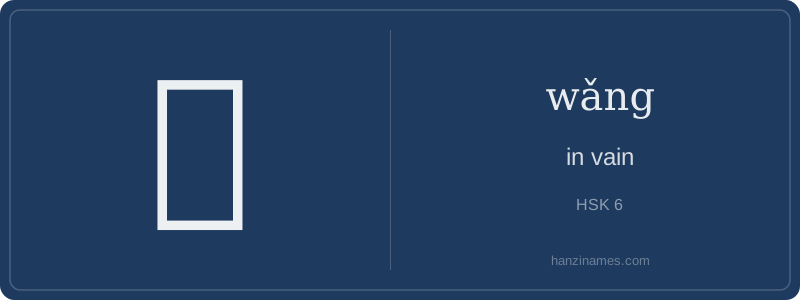
Today, 枉 appears most commonly in formal, critical contexts: legal discourse, moral philosophy, and idioms expressing futility or injustice. Key phrases include 枉费心机 (wǎngfèi xīnjī, ‘to waste mental effort’) and 不枉此行 (bù wǎng cǐ xíng, ‘this trip was not in vain’). It’s frequent in news headlines criticizing wrongful convictions (如‘冤枉’/‘yuanwang’, though note: 冤 is distinct, 枉 often co-occurs in compounds like 枉判 ‘unjust verdict’).
The character’s form has no pictographic origin—it evolved from seal script where 木 (wood) combined with 王 (authority/ruler), not ‘king’ literally, but phonetically (wǎng sound). Its structure reflects semantic-phonetic construction: 木 signals association with natural uprightness, while 王 provides pronunciation. In modern life, Chinese speakers use 枉 most often in the fixed phrase 不枉 (bù wǎng), meaning ‘not in vain’, e.g., ‘不枉我等了两小时’—a pragmatic, everyday affirmation of justified effort.
As an archaeologist brushing dust from a Han dynasty bamboo slip, I find 枉 inscribed in clerical script—not as a tree bent by wind, but as a legal metaphor etched into administrative records. Its ‘wood’ radical (木) anchors it in the material world, yet its right side, 王 (wáng), evokes authority: a ruler’s decree that distorts justice. This isn’t mere physical twisting—it’s moral torsion: truth warped by power, effort misdirected by error.
Excavations at Zhangjiashan (186 BCE) reveal 枉 in early legal texts like the *Book of Statutes and Ordinances*, where 枉法 (wǎngfǎ) means ‘to pervert the law’. The character appears not in poetic nature descriptions, but in indictments—highlighting systemic injustice. Its eight strokes encode a quiet indictment: wood (the upright standard) compromised by royal authority (王), suggesting legitimacy weaponized against fairness.
Unlike pictographic characters born from suns or rivers, 枉 emerged from bureaucratic reality. No oracle bone form survives; its earliest secure attestation is in Warring States bamboo manuscripts, always in juridical or ethical contexts. It speaks to Confucian anxieties about rectitude—Mencius warns that ‘a ruler who acts 枉 harms the people’s trust’. Thus, 枉 is less a shape and more a scar on the body of classical Chinese ethics: the moment principle bends under pressure.
Example Sentences
Common Compounds
Similar Characters — Don't Mix These Up
Your First Step into Chinese Culture: Get a Chinese Name
Every journey into Chinese begins with a name. Use our free Chinese name generator to create a meaningful, personalized Chinese name that fits you perfectly.
Get My Chinese Name →