框
Character Story & Explanation
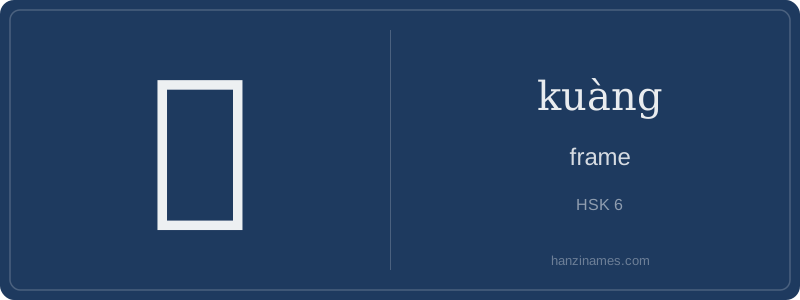
In daily Chinese, 框 most commonly appears in digital and print contexts: 'dialogue box' (对话框), 'text box' (文本框), and 'frame rate' (帧率, though 帧 is primary, 框 appears in colloquial usage like '卡在框里'—'stuck in the frame'). It’s frequent in HSK 6 vocabulary lists and official computer literacy standards (e.g., China’s National Computer Rank Examination). Historically, it appears in Ming-Qing furniture catalogs describing 'four-legged frame beds' (架子床的框体).
The character is not pictographic in origin—it evolved from seal script where 木 and 匡 merged phonetically and semantically. Its earliest attested form (late Warring States bamboo slips) shows clear 木 + 匡 structure, confirming its compound nature. Today, users encounter it constantly: selecting 'Insert > Text Box' in WPS Office displays 框 in the toolbar tooltip—real, functional, ubiquitous.
As an archaeologist brushing dust from a Tang-dynasty lacquered wooden box, I found the character 框 etched faintly on its inner rim—its 木 (wood) radical unmistakable, evoking the original material of frames: carved timber. Ten strokes coalesce into a structural boundary—neither ornamental nor incidental, but functional, defining space like a doorway or scroll mount. This wasn’t mere decoration; it was architectural language in script.
The character’s composition reveals ancient pragmatism: left-side 木 signals origin in woodcraft; right-side 匡 (kuāng) provides both sound and semantic weight—it originally meant 'to correct' or 'to contain', implying a frame’s role in ordering, stabilizing, and delimiting visual or physical fields. In Song-era painting inscriptions, 框 appears in colophons noting mounting dimensions—evidence that framing was already a codified craft.
Unlike abstract glyphs born of divination, 框 emerged from workshop practice—not oracle bones, but carpenter’s plans. Its stability across 1,200 years testifies to enduring function: whether enclosing a Ming dynasty hanging scroll or a modern smartphone screen, 框 persists as the silent boundary-maker. Even today’s UI designers unknowingly echo Song cabinetmakers when they ‘draw a frame’—a continuity written in ten deliberate strokes.
Example Sentences
Common Compounds
Similar Characters — Don't Mix These Up
Your First Step into Chinese Culture: Get a Chinese Name
Every journey into Chinese begins with a name. Use our free Chinese name generator to create a meaningful, personalized Chinese name that fits you perfectly.
Get My Chinese Name →