梁
Character Story & Explanation
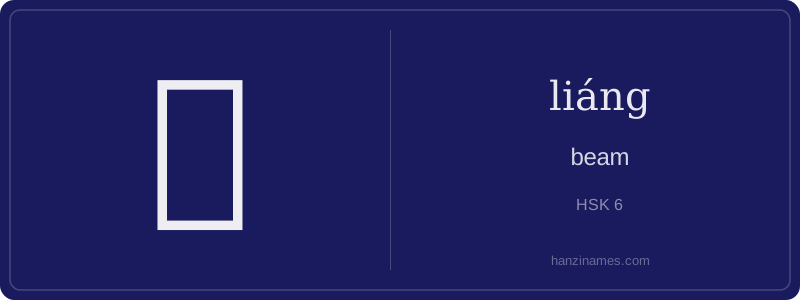
In modern Chinese, 梁 most commonly appears in proper nouns: surnames (e.g., Liang Qichao), place names (Liangshan County), and historical terms like 南梁 (Nán Liáng, 'Southern Liang'). It’s also embedded in idioms such as ‘栋梁之才’ (dòngliáng zhī cái, 'a pillar of talent'), reflecting its enduring architectural metaphor for foundational strength. In daily life, it’s rarely used alone — almost always within compounds or names.
The character’s form is documented as a phono-semantic compound since the Warring States bamboo slips: 木 (wood) + 弓 (bow, later stylized into the current 尨-like component) — not a pictograph, but a deliberate fusion where 木 signals material origin and the right side approximates pronunciation. No oracle bone form survives, confirming its later emergence in the Zhou bronze script tradition.
Our detective begins at the Shāng dynasty oracle bones — but here, no clear pictograph emerges for 梁. Instead, early bronze inscriptions (c. 11th–3rd century BCE) show 梁 as a phonosemantic compound: the 木 (mù, 'tree') radical hints at its original meaning — a load-bearing timber beam — while the right side, 弓 (gōng, 'bow'), later simplified to 尨 (liáng), served as a phonetic clue. This structural logic reflects how Chinese characters evolved not from pure pictures, but from functional combinations of meaning and sound.
By the Warring States period, 梁 had solidified its dual identity: physically, it meant 'horizontal beam' or 'ridgepole' — critical in classical architecture — and metaphorically, it implied 'support', 'foundation', or 'pillar'. This semantic weight made it a natural choice for dynastic names: the Liang Dynasty (502–557 CE) positioned itself as the structural backbone of cultural continuity after the fall of the Southern Dynasties’ Jin regime.
Though often associated with the Liang Dynasty today, that usage is purely nominal — a homophonic borrowing. The character itself carries no inherent dynastic meaning; rather, Emperor Xiao Yan chose 梁 as his dynasty’s name because his ancestral fief was in Liang Commandery (modern-day Shaanxi). Thus, the historical link is geopolitical, not lexical — a reminder that Chinese characters gain layered significance through repeated, context-driven usage across millennia.
Example Sentences
Common Compounds
Similar Characters — Don't Mix These Up
Your First Step into Chinese Culture: Get a Chinese Name
Every journey into Chinese begins with a name. Use our free Chinese name generator to create a meaningful, personalized Chinese name that fits you perfectly.
Get My Chinese Name →