棉
Character Story & Explanation
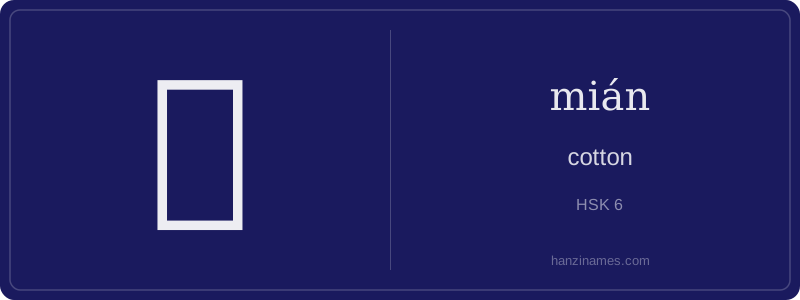
Historically, 棉 appears in Ming and Qing agricultural manuals like Xu Guangqi’s Nongzheng Quanshu (1639), documenting cotton farming techniques and state-sponsored ginning mills. In daily life, it’s ubiquitous: ‘棉衣’ (mián yī, cotton-padded coat) is winter standard across northern China; ‘医用棉’ (yīyòng mián, medical cotton) is sterilized gauze sold in every pharmacy. It’s central to the phrase ‘棉纺厂’ (mián fǎng chǎng, cotton spinning mill)—a pillar of 20th-century industrial policy.
The character’s form has no verified pictographic origin. It evolved from seal script variants combining 木 (wood/tree, indicating plant origin) and 厶 (a phonetic component related to *mián*). Its modern shape solidified in regular script during the Tang–Song transition—not as a drawing of cotton, but as a phonosemantic compound grounded in botany and sound.
As an archaeologist sifting through Han dynasty bamboo slips and Tang textile records, I found 棉 not in oracle bones—but in late imperial documents where it quietly replaced hemp as China’s dominant fiber. Its emergence reflects a material revolution: cotton cultivation spread from Xinjiang and Yunnan after the 8th century, gaining imperial support by the Song, then exploding in Jiangnan during the Ming. The character itself bears no ancient pictographic trace of bolls or fluff—its 'wood' radical (木) signals botanical origin, not literal timber.
This character is a linguistic fossil of technological adoption. Before 棉, Chinese textiles relied on silk, ramie, and hemp; 棉 marks the moment cotton became democratized clothing. Excavated Ming-era cotton quilts from Jiangsu—stitched with 棉 thread, labeled in ink with the character—confirm its functional, not poetic, early usage. No classical poetry invokes 棉 for metaphor; it entered lexicons as a pragmatic label for fiber, cloth, and padding—hence its HSK 6 status: essential for modern life, but rare in pre-modern literary texts.
Its 12-stroke form stabilized during the Song standardization of clerical script. The top component 丷+口+厶 (a simplified variant of 絹’s phonetic element) hints at phonetic borrowing—likely from *mián* as a loan adaptation for foreign-grown kapok (Ceiba pentandra) and later Gossypium species. Unlike ideographs born of observation, 棉 was forged in trade routes and tax registers: a bureaucratic character that clothed a nation.
Example Sentences
Common Compounds
Similar Characters — Don't Mix These Up
Your First Step into Chinese Culture: Get a Chinese Name
Every journey into Chinese begins with a name. Use our free Chinese name generator to create a meaningful, personalized Chinese name that fits you perfectly.
Get My Chinese Name →