椭
Character Story & Explanation
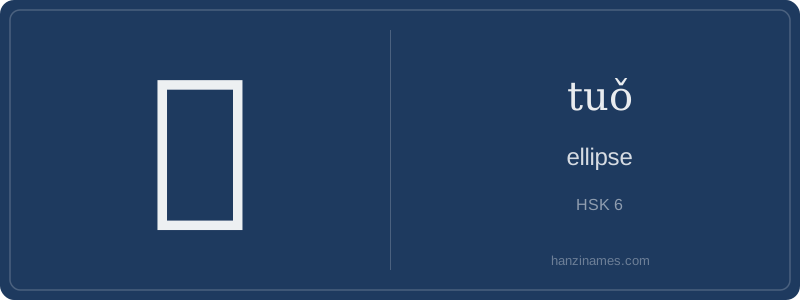
In China’s national curriculum, 椭 appears in junior high mathematics textbooks (e.g., People’s Education Press Grade 9) when introducing conic sections. It’s standard in engineering exams and university entrance assessments (Gaokao math sections), where students calculate ellipse foci or sketch 椭圆 curves. The term is also embedded in real infrastructure: Shanghai Metro Line 17’s Zhujiajiao Station features an elliptical vaulted ceiling explicitly labeled 椭圆形结构 in official design documents.
The character is a phono-semantic compound: 木 (radical, indicating category—though historically unrelated to wood) + 陮 (phonetic, now obsolete as a standalone character). No oracle-bone or bronze inscription evidence exists for 椭; it first appeared reliably in Song-dynasty dictionaries like the Jiyun (1037 CE) as a technical term for non-circular ovals, reflecting growing mathematical sophistication.
The character 椭 (tuǒ) represents 'ellipse'—a precise geometric shape widely used in mathematics, engineering, and design across China. Though not part of daily conversational vocabulary, it appears frequently in academic textbooks, technical blueprints, and STEM education. Its inclusion in HSK Level 6 reflects its role as a specialized term mastered only after years of formal study, signaling advanced literacy in scientific Chinese.
Visually, 椭 combines the 木 (mù, 'tree') radical with a phonetic component 陮 (tuǒ), suggesting historical roots in phonetic-semantic compound formation. Despite the wood radical, there’s no botanical meaning—it’s purely structural. This illustrates how Chinese characters often repurpose radicals for sound or form rather than semantics, a key insight for learners navigating abstract terminology.
In modern usage, 椭 rarely stands alone but appears in compound nouns like 椭圆形 (tuǒyuánxíng, 'oval/elliptical shape') or 椭圆率 (tuǒyuánlǜ, 'eccentricity'). It’s essential in physics (e.g., planetary orbits) and architecture (e.g., elliptical arches in Beijing’s National Centre for the Performing Arts). Mastery signals fluency in technical discourse—not just language, but conceptual precision.
Example Sentences
Common Compounds
Similar Characters — Don't Mix These Up
Your First Step into Chinese Culture: Get a Chinese Name
Every journey into Chinese begins with a name. Use our free Chinese name generator to create a meaningful, personalized Chinese name that fits you perfectly.
Get My Chinese Name →