栏
Character Story & Explanation
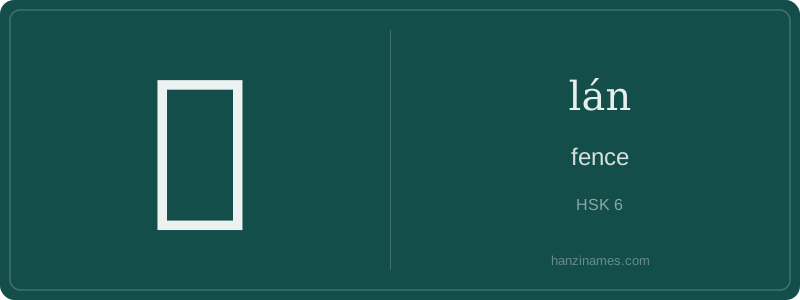
In daily life, 栏 appears ubiquitously: ‘栏目’ (lánmù) labels TV program segments, news website sections, and even Excel spreadsheet columns. Historically, during the Ming and Qing dynasties, ‘栏’ appeared in architectural texts like the Yingzao Fashi (1103 CE) to denote balustrades in palaces and temples — always specifying wooden or stone perimeter railings. It’s also in the idiom ‘隔栏相望’ (gélán xiāng wàng), meaning ‘to gaze at each other across a fence’, used in classical poetry to express restrained longing.
The character is not pictographic in origin — no oracle bone or bronze script forms exist. Instead, it emerged in Warring States bamboo slips as a phono-semantic compound: 木 (wood, semantic) + 兰 (lán, phonetic, later simplified from 欄). Today, Chinese people instantly recognize 栏 in contexts like ‘报名栏’ (bàomíng lán, registration form field) or ‘广告栏’ (guǎnggào lán, bulletin board) — always signaling a bounded, designated space.
Our detective begins at the scene: the character 栏 (lán) — nine strokes, wood radical (木), HSK 6. At first glance, it’s a fence — but why wood? Because ancient Chinese fences were built from wooden posts and rails. The right side, 兰 (lán), isn’t just phonetic decoration; it anchors the sound while subtly evoking layered, interwoven structure — like slats in a barrier. This duality of material (wood) and function (division/containment) is foundational.
Zooming in on the script evolution: in seal script (c. 220 BCE), 栏 clearly shows vertical wooden stakes (the 木 radical) flanking a simplified ‘lan’ shape representing horizontal rails. No oracle bone form survives — this is a later, practical character born from construction, not divination. Its consistency across clerical and regular scripts confirms its functional origin: it was *needed* to describe enclosures in agriculture, architecture, and urban planning.
The detective notes a linguistic twist: while ‘fence’ is the core meaning, modern usage leans heavily into *abstract boundaries*. A news website’s ‘栏目’ (lánmù) isn’t a physical rail — it’s a conceptual column or section. Likewise, ‘栏杆’ (lángān) means railing, but ‘填栏’ (tián lán) means ‘fill in the blank’ — literally ‘fill the column’. The character evolved from timber barrier to organizational unit, mirroring China’s shift from agrarian enclosures to digital information architecture.
Example Sentences
Common Compounds
Similar Characters — Don't Mix These Up
Your First Step into Chinese Culture: Get a Chinese Name
Every journey into Chinese begins with a name. Use our free Chinese name generator to create a meaningful, personalized Chinese name that fits you perfectly.
Get My Chinese Name →