歧
Character Story & Explanation
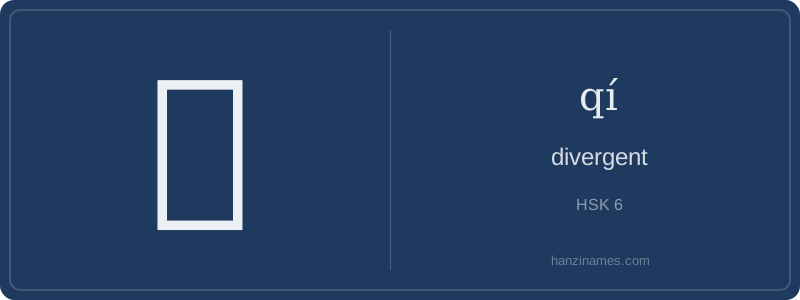
歧 appears in high-frequency formal contexts: official media warnings against 'ideological divergence' (思想歧义), academic debates on 'interpretive divergence' (阐释歧义), and public health messaging about 'reducing diagnostic divergence' among doctors. It features prominently in the idiom 歧路亡羊 (qí lù wáng yáng)—'lose the sheep at the crossroads'—from the Zhuangzi (c. 3rd century BCE), illustrating how excessive options or unclear principles lead to failure. Modern usage includes '歧义' (qíyì, 'ambiguity') in linguistics and AI training datasets.
The character 歧 evolved from seal script (c. 200 BCE), where it combined 止 ('to stop', radical) and 支 ('branch, support'). This structure visually encodes 'a point where paths stop and branch'—not an abstract idea, but a literal crossroads. No oracle-bone form survives, but its Warring States–era structure confirms its ancient association with choice-points and consequential divergence.
歧 (qí) is a sophisticated character denoting divergence, branching, or deviation—often implying a departure from unity, orthodoxy, or consensus. Unlike simple synonyms like 'different', 歧 carries connotations of potential conflict, ambiguity, or ideological split. It appears frequently in formal, academic, and political discourse, especially when discussing social divisions, interpretive disagreements, or policy alternatives. Its nuance lies in the implication of consequential separation—not just difference, but a fork with real-world ramifications.
In Western thought, 'divergent' evokes scientific or mathematical imagery—like divergent series or evolutionary divergence—but 歧 adds moral and sociopolitical weight. Compare it to English terms like 'schism' (ecclesiastical rupture), 'bifurcation' (technical splitting), or 'heresy' (doctrinal deviation). Yet 歧 is more flexible: it can describe harmless interpretive differences in literary criticism or deeply entrenched societal rifts—context determines its gravity.
Culturally, 歧 reflects Confucian and Daoist tensions between harmony (和, hé) and differentiation. While classical Chinese philosophy values unity-in-diversity, 歧 often signals a breakdown of that balance—hence its prominence in modern discussions of polarization, misinformation, and identity politics. Unlike Western individualism’s celebration of divergence, 歧 subtly warns: divergence without dialogue risks fragmentation. This makes it a critical lexical tool for analyzing China’s contemporary social discourse—and a subtle mirror to global democratic challenges.
Example Sentences
Common Compounds
Similar Characters — Don't Mix These Up
Your First Step into Chinese Culture: Get a Chinese Name
Every journey into Chinese begins with a name. Use our free Chinese name generator to create a meaningful, personalized Chinese name that fits you perfectly.
Get My Chinese Name →