殃
Character Story & Explanation
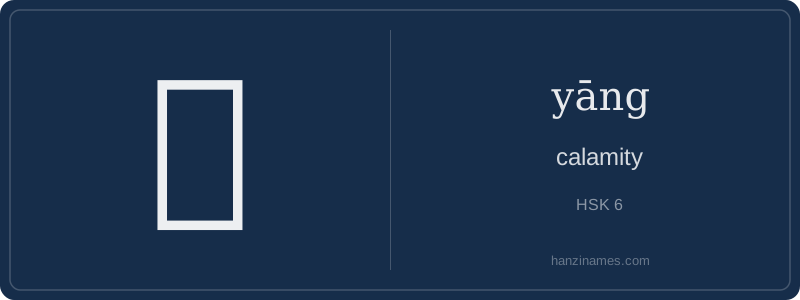
殃 appears frequently in classical and modern Chinese in formal, literary, or cautionary contexts—not in casual speech. It features prominently in idioms like 自取其殃 (zì qǔ qí yāng, 'to bring calamity upon oneself') and the classical phrase 祸国殃民 (huò guó yāng mín, 'to bring disaster to the nation and calamity to the people'), used historically to condemn corrupt officials and still deployed in political discourse today. Modern usage includes news headlines warning of environmental policies that might 'yāng' future generations.
The character’s form dates to the Warring States period (475–221 BCE), evolving from earlier seal script. Its left side 歹 is a recognized death-related radical; the right side 央 (yāng) originally meant 'center' but here serves phonetically. There is no verified pictographic origin—no oracle bone form survives—and scholars agree it’s a phono-semantic compound, not a pictograph.
The character 殃 (yāng) embodies a profound Chinese worldview where misfortune is rarely random—it is often seen as the karmic or moral consequence of actions, whether personal, familial, or societal. Rooted in ancient cosmology and Confucian ethics, calamity is not merely external disaster but a sign of imbalance: disrupted harmony between heaven, earth, and humanity. This reflects the classical belief that virtue invites blessings, while wrongdoing invites retribution—even across generations.
In Daoist and folk traditions, 殃 carries subtle metaphysical weight: it denotes invisible, lingering negative energy—like spiritual contamination—that can 'infect' people or places. The radical 歹 (dǎi), meaning 'death' or 'decay', visually anchors this idea: calamity arises from what is already broken or dying. Thus, 殃 is not passive suffering but an active, almost contagious force tied to moral causality and relational ethics.
This worldview contrasts with Western notions of fate or pure chance. In Chinese thought, avoiding 殃 requires self-cultivation, ritual propriety, and communal responsibility—not just luck or divine intervention. Historical texts like the *Book of Rites* warn against inviting 殃 through arrogance or neglect; even architecture (e.g., feng shui) seeks to deflect it. To understand 殃 is to grasp how deeply ethics, environment, and existential risk are interwoven in traditional Chinese consciousness.
Example Sentences
Common Compounds
Similar Characters — Don't Mix These Up
Your First Step into Chinese Culture: Get a Chinese Name
Every journey into Chinese begins with a name. Use our free Chinese name generator to create a meaningful, personalized Chinese name that fits you perfectly.
Get My Chinese Name →