残
Character Story & Explanation
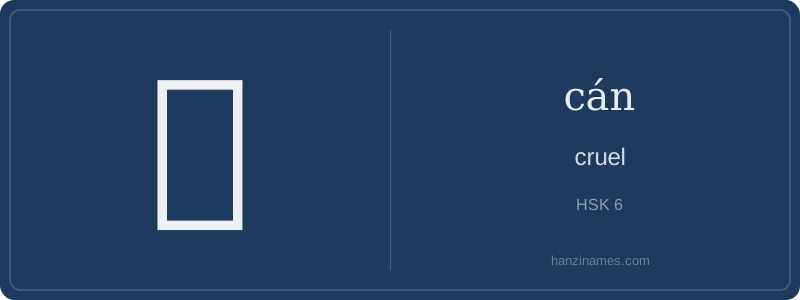
In modern Chinese, 残 most commonly appears in formal, literary, or morally charged contexts — rarely in casual speech. It’s central to the idiom 残酷无情 (cánkù wúqíng, 'brutally heartless'), used in historical documentaries and human rights discourse. Legally, it appears in statutes like 刑法第234条 (Criminal Law Article 234) concerning 'intentional injury' (故意伤害罪), where 残害 (cánhài, 'to maltreat/maim') denotes severe bodily harm. News reports describe wartime atrocities using 残杀 (cánshā, 'massacre'). It also appears in disability advocacy: 残疾人 (cánjírén, 'person with disability') literally means 'injured/defective person' — a term historically rooted in medical-classical usage, now undergoing semantic rehabilitation.
The character’s form has a clear, documented origin: 歹 is a corrupted form of 歹 (gǔ), an ancient pictograph of a skeleton or exposed bones (seen in bronze inscriptions), while 戔 is a phonetic loan from a graph representing crossed weapons. No oracle bone form of 残 exists; its earliest confirmed appearance is in Warring States bamboo manuscripts, confirming its late emergence as a specialized term for violent harm.
As an archaeologist brushing dust from a Warring States bamboo slip, I uncover 残 not as a simple verb for 'to destroy', but as a lexical fossil encoding ancient trauma. Its radical 歹 (dǎi) — the 'corpse' component — anchors it in mortality and decay, appearing in characters like 死 (death) and 殃 (calamity). This isn’t abstract destruction; it’s visceral, post-battle ruin — shattered limbs, scorched fields, broken ritual vessels. The right side, 戔 (jiān), originally depicted two spears crossing — a glyph of violent confrontation now phonetic. Together, they form a semantic-phonetic compound where meaning and sound converge on irreversible damage.
The character’s earliest attested use appears in Han dynasty texts like the *Shuowen Jiezi* (121 CE), which defines 残 as ‘to harm, to injure, to leave remnants after violence’ — revealing its core duality: both the act of destruction *and* its lingering aftermath. Unlike generic verbs like 毁 (huǐ, ‘to ruin’), 残 carries moral weight: it implies wanton, often unjustified harm — a warlord’s massacre, a tyrant’s purge. This ethical dimension persisted through Tang legal codes and Ming novels, where 残 always connotes cruelty or excess, never mere accident.
In excavating oracle bone or bronze inscriptions, we find no direct precursor to 残 — it likely emerged in the late Zhou period as warfare intensified and bureaucratic record-keeping demanded precise terms for atrocity. Its nine-stroke structure stabilized by the Qin standardization, with the final dot stroke (丶) sealing the radical — a subtle yet deliberate mark of finality, like a seal pressed onto a death warrant. To write 残 is thus to reenact an ancient gesture of judgment: not just breaking something, but declaring it irrevocably broken.
Example Sentences
Common Compounds
Similar Characters — Don't Mix These Up
Your First Step into Chinese Culture: Get a Chinese Name
Every journey into Chinese begins with a name. Use our free Chinese name generator to create a meaningful, personalized Chinese name that fits you perfectly.
Get My Chinese Name →