殿
Character Story & Explanation
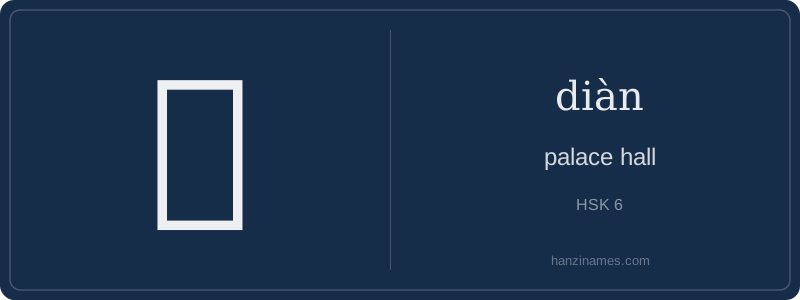
殿 is widely used in historical site names (e.g., 大雄宝殿 dàxióng bǎo diàn—the Mahavira Hall in Buddhist temples) and imperial architecture terminology. It appears in the HSK 6 curriculum due to its frequency in formal texts, historical novels, and cultural heritage contexts. Common idioms include 殿后 (diànhòu)—literally 'to guard the rear'—now meaning 'to bring up the rear' or 'to finish last', preserving its original military-architectural sense from ancient troop formations.
The character’s form combines 殳 (shū, a hand holding a weapon, often indicating action or authority) and 共 (gòng, 'together', 'shared'), suggesting a space of collective ritual under authority. While not a pictograph, its bronze script origins (c. 1000 BCE) show clear association with structured, elevated architecture—verified in inscriptions on Zhou dynasty ritual bronzes referencing temple halls.
The Chinese character 殿 (diàn) originally denoted the rear section of a grand ancestral or imperial hall—later evolving to mean any major ceremonial hall within palace complexes, temples, or official architecture. Unlike Western ‘palace’ (which emphasizes residence), 殷 stresses function: it is where rituals, audiences, and state ceremonies occurred. Its architectural connotation remains central—even today, it appears in names of historic halls like the Hall of Supreme Harmony (太和殿, Tàihé Diàn) in Beijing’s Forbidden City.
In classical usage, 殿 also carried honorific weight: it was used posthumously for revered figures (e.g., 孔子殿, Confucius Hall) or as a respectful title suffix (e.g., 佛殿, Buddha Hall). This parallels Western ‘sanctuary’ or ‘chapel’ but with stronger ties to imperial authority and Confucian ritual hierarchy—not just worship, but cosmological order made manifest in space.
Compared to Western equivalents like ‘cathedral’, ‘throne room’, or ‘capitol’, 殿 is more structurally precise and less institutionally fluid. A cathedral houses worship *and* administration; 殿, by contrast, is fundamentally architectural and ceremonial—never administrative alone. Its semantic field excludes private residence (that’s 宫 gōng) and secular governance (that’s 朝 cháo or 阁 gé). This precision reflects China’s historical emphasis on spatial semantics in statecraft and ritual.
Example Sentences
Common Compounds
Similar Characters — Don't Mix These Up
Your First Step into Chinese Culture: Get a Chinese Name
Every journey into Chinese begins with a name. Use our free Chinese name generator to create a meaningful, personalized Chinese name that fits you perfectly.
Get My Chinese Name →