殴
Character Story & Explanation
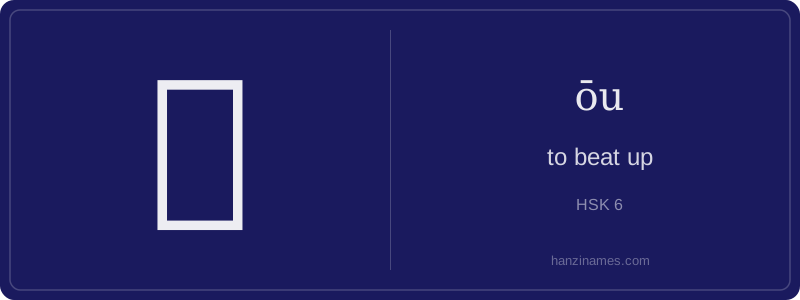
In contemporary Chinese usage, 殴 appears primarily in legal, news, and administrative language—not in daily conversation. It’s most commonly found in compounds like 殴打 (ōudǎ, 'to assault') and in official reports on public order incidents. The phrase 聚众斗殴 (jùzhòng dòu'ōu, 'group brawling') is a defined criminal offense under China’s Criminal Law, frequently cited in court rulings and police bulletins. Media avoid using 殴 alone; instead, they specify context (e.g., ‘殴打他人’ — 'assaulting another person') to meet legal precision standards.
The character combines the radical 殳 (shū), historically representing a hand-held weapon or club, with 区 (qū), serving phonetically. Seal script inscriptions from the Qin dynasty (3rd c. BCE) already show this structure, confirming its early association with violent action. No pictographic origin survives, but its consistent use in Warring States bamboo texts (e.g., *Shuoyuan*) to denote punitive striking confirms its longstanding legal-moral valence.
The Chinese character 殴 (ōu) conveys a forceful, physical act of striking or beating—often implying aggression, violence, or assault. Unlike English verbs like 'hit' or 'punch', which can be neutral or even playful (e.g., 'hit the ball'), 殴 carries an unmistakably negative, unlawful, or socially condemned connotation. It appears almost exclusively in formal, legal, or journalistic contexts—not in casual speech—and is rarely used alone as a verb in modern spoken Mandarin.
In Western cultural frameworks, equivalent terms include 'assault' (legal), 'brawl' (colloquial), or 'pummel' (intensified physical attack). But where English may distinguish degrees via modifiers ('slap', 'shove', 'thrash'), 殴 is inherently severe: it implies repeated, harmful blows—not a single gesture. Its semantic weight aligns more closely with 'battery' in U.S. law than with everyday synonyms for hitting.
Crucially, 殴 does not appear in idioms celebrating strength (e.g., no Chinese counterpart to 'beat the odds'). Instead, it anchors legally precise compounds like 殴打 (ōudǎ, 'to assault physically') and appears in statutes such as Article 234 of China’s Criminal Law (intentional injury). This reflects Confucian-influenced legal tradition: violence is codified as deviance, not valorized—unlike Western martial archetypes (e.g., knightly combat) where physical force may carry honor.
Example Sentences
Common Compounds
Similar Characters — Don't Mix These Up
Your First Step into Chinese Culture: Get a Chinese Name
Every journey into Chinese begins with a name. Use our free Chinese name generator to create a meaningful, personalized Chinese name that fits you perfectly.
Get My Chinese Name →