氓
Character Story & Explanation
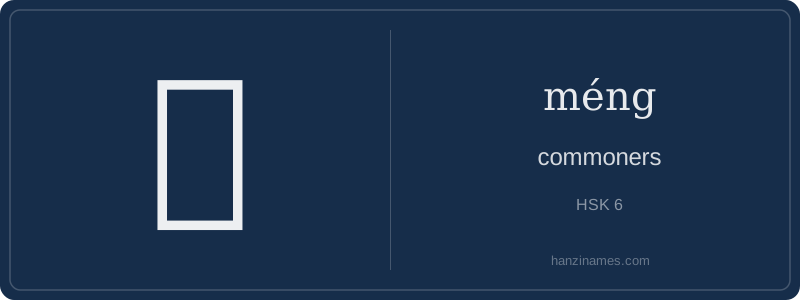
In classical Chinese literature — especially the Shijing (Book of Songs, c. 11th–7th centuries BCE) — 氓 appears in the famous poem 'Méng' (《氓》), describing a betrayed woman reflecting on her marriage to a 'common man'. Historically, it referred to non-aristocratic male residents, often contrasted with officials or scholars. Today, it survives primarily in literary, academic, or legal contexts — e.g., in phrases like 氓流 (méngliú, 'itinerant commoners'), though this usage is now rare and sometimes archaic or pejorative.
The character evolved from seal script, where 民 depicted a kneeling person with an eye covered (suggesting subjugation), and 亡 was added later for sound. No oracle bone form survives, but early bronze inscriptions confirm its use by the Warring States period to denote ordinary subjects of a state.
Hi students! Let’s learn 氓 (méng) — a character you’ll encounter in advanced reading, especially classical or historical texts. Though it looks simple (just 8 strokes!), its meaning has shifted over time. Originally, it meant 'common people' or 'ordinary citizens', often with a neutral or even respectful tone — think of farmers, artisans, or townsfolk outside the nobility. It appears frequently in ancient poetry and official documents to refer to the general populace.
This character is built from the radical 民 (mín), meaning 'the people', which appears in words like 民主 (democracy) and 民族 (ethnic group). The right side, 亡 (wáng), means 'to perish' or 'to lose', but here it serves mainly as a phonetic component — helping signal pronunciation rather than contributing literal meaning. So don’t read it as 'lost people' — that’s a common beginner misconception!
Be careful: modern spoken Chinese rarely uses 氓 alone. In everyday speech, it’s almost always found in compound words or formal writing. Also, avoid confusing it with the homophone 芒 (máng, 'thorn') or 盟 (méng, 'alliance') — they sound similar but look and mean very different things. Practice writing it slowly: start with 民, then add 亡 — paying attention to stroke order and balance.
Example Sentences
Common Compounds
Similar Characters — Don't Mix These Up
Your First Step into Chinese Culture: Get a Chinese Name
Every journey into Chinese begins with a name. Use our free Chinese name generator to create a meaningful, personalized Chinese name that fits you perfectly.
Get My Chinese Name →