沛
Character Story & Explanation
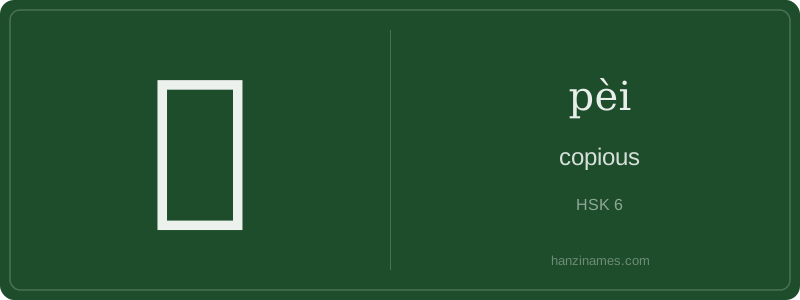
In modern Chinese, 沛 appears most frequently in formal, literary, or idiomatic contexts—never in casual speech. It’s central to the classical idiom pèi rán ér zhì (沛然而至), meaning 'arriving in overwhelming, unstoppable abundance', used in historical narratives and political rhetoric to describe surges of public support or natural forces. It also appears in proper names (e.g., Pei County in Jiangsu) and poetic descriptions of rain, vitality, or moral vigor.
The character’s form is well-documented: it evolved from seal script where the right side clearly combined 市 (phonetic, *shì*) and 口 (semantic reinforcement for ‘outflow’ or ‘expression’). The water radical 氵 consistently signals its conceptual root in fluid abundance—not a pictograph of water itself, but a classifier anchoring it within China’s hydrological semantic field.
As an archaeologist brushing dust from a Han dynasty bamboo slip, I find 沛 inscribed in elegant clerical script—its three water dots (氵) flowing like a spring bursting from limestone, its 口 (mouth) and 市 (market-like structure) suggesting abundance made manifest: not just water, but life-sustaining overflow. The character doesn’t merely depict volume—it encodes *vitality in motion*, the kind that fills rivers after monsoon rains or swells a harvest beyond expectation.
This is no static symbol. Excavated texts—from the Shuōwén Jiězì (121 CE) to Tang steles—consistently link 沛 with plenitude that is dynamic, nourishing, and socially consequential. When Sima Qian wrote of Liu Bang’s ‘peì dé’ (沛德), he meant moral abundance so overflowing it reshaped dynasties—not mere quantity, but generative power that rippled outward.
Modern paleography confirms its structural integrity: the radical 氵 anchors it in the hydrological lexicon (like 河, 海, 泽), while the right side, though simplified today to 市+口, preserves ancient phonetic-semantic fusion. Its stability across 2,000 years testifies not to rigidity, but to enduring cultural valuation of *abundance that serves*—not hoarded wealth, but water that irrigates, energy that empowers, virtue that inspires.
Example Sentences
Common Compounds
Similar Characters — Don't Mix These Up
Your First Step into Chinese Culture: Get a Chinese Name
Every journey into Chinese begins with a name. Use our free Chinese name generator to create a meaningful, personalized Chinese name that fits you perfectly.
Get My Chinese Name →