沸
Character Story & Explanation
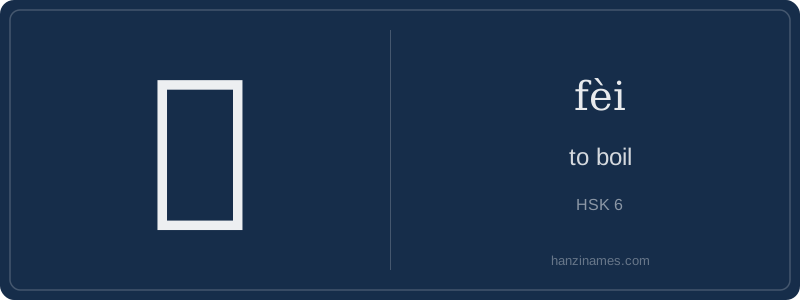
沸 appears frequently in modern Chinese media and daily speech to describe intense, often collective, emotional or social states—e.g., 舆论沸腾 (yùlùn fèiténg, 'public opinion boils') is a common phrase in news reports about viral controversies. It’s also central to culinary terms like 沸水 (fèishuǐ, 'boiling water') and idioms like 沸反盈天 (fèifǎn yíngtiān, 'uproar filling the sky'), documented since the Ming dynasty novel *Jin Ping Mei*. Historically, it was used in medical texts like the *Huangdi Neijing* to describe pathological heat surges in the body.
The character evolved from seal script, where 氵 (water) + 弗 (a phonetic component meaning 'not' or 'to negate', here indicating resistance overcome) visually conveys water defying stillness. No oracle bone form survives, but its structure consistently emphasizes water in active transformation—not static heat, but the *process* of becoming agitated.
The character 沸 (fèi) embodies a dynamic, transformative moment in Chinese cosmology: the point where water—symbol of yin, stillness, and potential—reaches its energetic threshold and erupts into vigorous motion. This isn’t mere physical change; it reflects a core Daoist and Confucian insight: transformation arises not from force, but from natural accumulation reaching critical resonance. Boiling is thus a metaphor for societal awakening, intellectual ferment, or emotional intensity—always implying an inner pressure that must be acknowledged, not suppressed.
In classical texts, 沸 rarely describes kitchen pots alone. In the *Shijing* (Book of Odes), it evokes turbulent rivers and surging crowds—'the people boil with indignation'—linking thermal energy to moral urgency. The radical 氵 (water) anchors it in elemental reality, while the phonetic component 弗 (fú) hints at resistance overcome: boiling occurs when water ‘refuses’ to remain passive under heat. This duality—fluid yet forceful, yielding yet unstoppable—mirrors the ideal of *junzi* (noble person): adaptable as water, unshakable as its boiling point.
Modern usage preserves this philosophical weight. When Chinese media report 'public opinion boils' (舆论沸腾), they invoke centuries-old associations between heat, collective voice, and irreversible change. Even in tea culture—where precise water temperature governs flavor—boiling isn’t just technical; it’s a ritual threshold marking readiness, respect, and mindful transition. Thus, 沸 encodes a worldview where stillness and eruption are phases of one continuum, and true vitality emerges only when conditions align to release latent energy.
Example Sentences
Common Compounds
Similar Characters — Don't Mix These Up
Your First Step into Chinese Culture: Get a Chinese Name
Every journey into Chinese begins with a name. Use our free Chinese name generator to create a meaningful, personalized Chinese name that fits you perfectly.
Get My Chinese Name →