泊
Character Story & Explanation
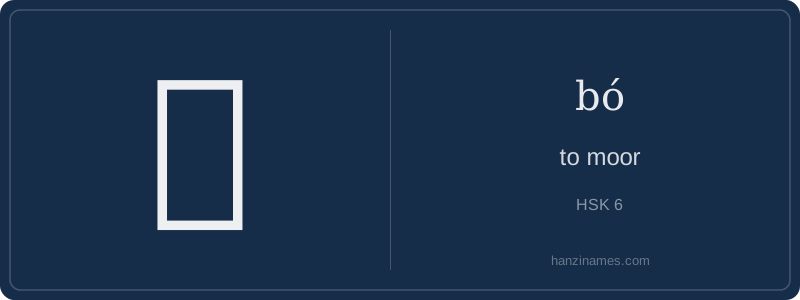
In modern China, 泊 appears daily in port signage (如:船舶停泊区 — 'vessel anchorage zone'), traffic apps (e.g., '附近可泊车位' — 'available parking spots nearby'), and maritime regulations. It’s central in phrases like 夜泊牛渚怀古 — a famous Tang poem by Li Bai describing anchoring at Niuzhu at night and reflecting on history — widely taught in middle schools. The character also appears in official documents from China’s Ministry of Transport regarding vessel berthing protocols.
The character 泊 first appeared in seal script during the Warring States period (475–221 BCE), evolving from a combination of 水 (water) and 白 (phonetic). Archaeological inscriptions on bronze vessels confirm its early use for 'anchoring'. Unlike myth-based stories, its origin is well-documented in paleographic studies — no oracle bone form survives, but its structure has remained remarkably stable for over 2,300 years.
Hi students! The character 泊 (bó) is a beautiful example of how Chinese characters combine meaning and sound. Its left side 氵is the 'water' radical — telling us it’s related to water, rivers, or docks. The right side 白 (bái) is a phonetic component that hints at pronunciation (though not exact — bó vs. bái). This structure helps you remember both meaning and sound together!
Don’t confuse 泊 with other ‘bó’ characters like 伯 (uncle) or 博 (broad). 泊 is specifically about ships, boats, or vehicles stopping safely on or near water. It’s a quiet, deliberate action — not just ‘stopping’, but anchoring, securing, resting in place. Think of a boat gently tying up at dusk: calm, intentional, and purposeful.
Although listed as HSK Level 6, 泊 appears frequently in formal writing, news reports about shipping, travel guides, and even poetic descriptions. You’ll also see it in compound words like 停泊 (tíngbó, 'to anchor') or 泊车 (bóchē, 'to park'). Note: when used for parking cars, it’s a modern extension — showing how language adapts while keeping its core meaning of 'secure stopping'.
Example Sentences
Common Compounds
Similar Characters — Don't Mix These Up
Your First Step into Chinese Culture: Get a Chinese Name
Every journey into Chinese begins with a name. Use our free Chinese name generator to create a meaningful, personalized Chinese name that fits you perfectly.
Get My Chinese Name →