波
Character Story & Explanation
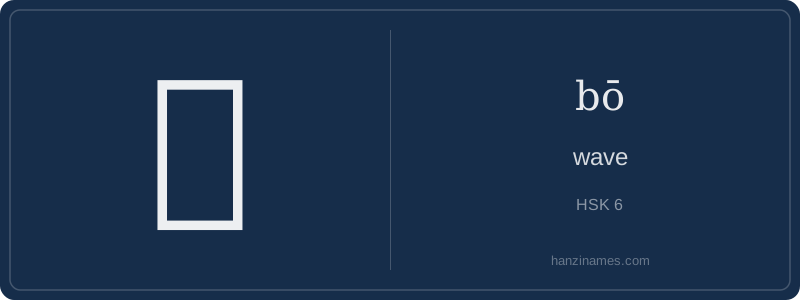
波 is ubiquitous in scientific, technical, and literary contexts: used daily in weather reports (海浪、声波), telecom discussions (5G信号波), and idioms like 推波助澜 (‘fan the flames’ — literally ‘push the waves and aid the surge’). It appears in the Tang dynasty poet Li Bai’s line ‘黄河之水天上来,奔流到 sea 不复回’ (though 波 itself appears in related variants in Song-era commentary on water imagery).
Historically, 波 was standardized as a left-water-right-皮 (氵+皮) structure by the Qin dynasty’s small seal script reforms. The water radical clearly signals its domain; 皮 (originally pronounced closer to *bā* in Old Chinese) served as the phonetic component — confirmed by phonological reconstructions and rhyme tables from the *Qièyùn* (601 CE). No oracle bone or bronze inscriptions contain 波; it emerged later in bamboo-slip manuscripts of the Warring States period.
The Chinese character 波 (bō) does not mean 'Poland'—this is a critical correction. 波 means 'wave' (as in water wave, radio wave, or emotional wave) and is unrelated to the country Poland, which is written 波兰 (Bōlán) — a phonetic transliteration where 波 serves only as a sound component. Confusing the standalone character with part of a proper noun is a common learner error.
Etymologically, 波 combines the water radical 氵 (indicating relation to liquid) with 皮 (pí, 'skin' or 'hide'), originally suggesting the 'skin-like surface' of rippling water — a semantic-phonetic compound where 皮 also provided early pronunciation cues. It appears in classical texts like the *Shuōwén Jiězì* (121 CE) as a character describing undulating motion.
In modern usage, 波 conveys rhythmic, oscillating phenomena: electromagnetic waves (无线电波), emotional fluctuations (心潮澎湃), or even metaphorical 'waves' of change (改革浪潮). Unlike English 'wave', it rarely functions as a verb ('to wave hello'); that role belongs to 挥 (huī). Its abstract extensions reflect how Chinese often grounds physics and emotion in shared natural imagery — much like 'tide' or 'current' in English, but with broader systematic application.
Example Sentences
Common Compounds
Similar Characters — Don't Mix These Up
Your First Step into Chinese Culture: Get a Chinese Name
Every journey into Chinese begins with a name. Use our free Chinese name generator to create a meaningful, personalized Chinese name that fits you perfectly.
Get My Chinese Name →