泥
Character Story & Explanation
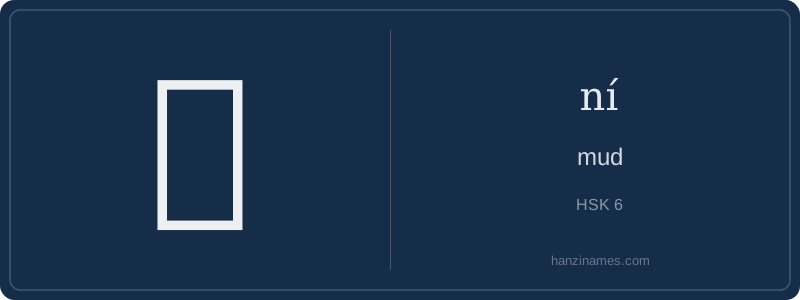
泥 is widely used in modern Chinese — from construction ('clay bricks' 黏土砖) and agriculture ('fertile mud' 肥泥) to idioms like 泥足巨人 (ní zú jù rén, 'colossus with feet of clay'), borrowed from Aesop and used in political commentary since the 1930s. It also appears in the classical phrase 泥牛入海 (ní niú rù hǎi, 'a clay ox entering the sea'), meaning 'vanishing without a trace', documented in Song-dynasty Chan Buddhist texts.
The character’s form evolved from seal script, where 氵 already represented water, and 尼 served as a phonetic guide. No oracle-bone version survives, but by the Han dynasty, 泥 was standardized as a phono-semantic compound — not a pictograph, but a functional blend reflecting both sound and semantic category.
Hi students! Let’s explore 泥 (ní), a Level 6 HSK character meaning 'mud' — soft, wet earth you might step in after rain or use for pottery. It’s written with just 8 strokes and features the water radical 氵 on the left, telling us it’s closely tied to liquids or dampness. Though simple in form, 泥 carries rich practical and figurative weight in Chinese — from describing physical soil to expressing stubbornness or being 'stuck' in thought.
The character has two pronunciations: ní (most common, meaning 'mud') and nì (used only in specific compound verbs like 泥古 'to rigidly adhere to ancient ways'). This tone shift signals a change in grammatical function — not a different object, but a different *action* involving mud-like rigidity. Don’t worry — you’ll almost always use ní in daily speech!
Because 泥 contains 氵 (water) + 尼 (a phonetic component), it’s a classic example of a phono-semantic compound — where one part hints at sound (尼, ní), and another at meaning (氵, water-related). This structure appears across hundreds of characters, so mastering it helps you decode many others. Think of 氵 as your 'wetness alert' — whenever you see it, expect something fluid, muddy, or soaked!
Example Sentences
Common Compounds
Similar Characters — Don't Mix These Up
Your First Step into Chinese Culture: Get a Chinese Name
Every journey into Chinese begins with a name. Use our free Chinese name generator to create a meaningful, personalized Chinese name that fits you perfectly.
Get My Chinese Name →