泄
Character Story & Explanation
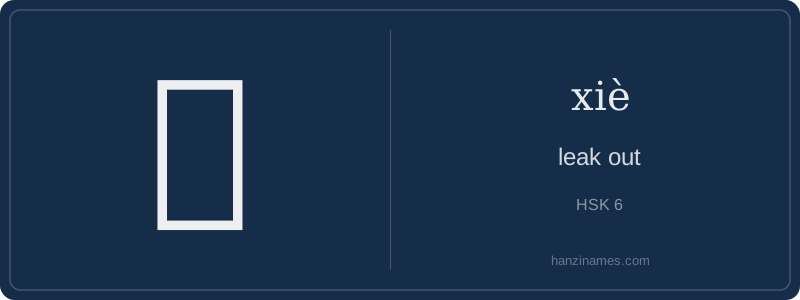
泄 is widely used in modern Chinese across technical, medical, and political domains. It appears in official terms like 泄密 (xièmì, 'disclose classified information'), a key concept in China’s State Secrecy Law (2010 revision), and in health contexts like 泄火 (xiè huǒ, 'clear internal heat') in TCM clinics. The idiom 泄露天机 (xièlù tiānjī, 'leak heavenly secrets')—used since at least the Ming dynasty—warns against revealing fated or profound truths, reflecting Daoist and folk cosmological beliefs.
The character evolved from seal script, where the left side 氵 (water) combined with 又 (a hand-like component, later stylized) and 世 (shì, 'generation' or 'world')—though its earliest form (in bronze inscriptions) shows water + 'to let go'. Modern standard form fixes the right as 世, but this is phonetic, not semantic; the core idea remains 'unrestrained outflow'. Today, Chinese people commonly type 泄 in news headlines about data breaches or in WeChat health tips advising 'don’t suppress anger—let it out (泄出来)'.
The Chinese character 泄 (xiè) embodies the concept of uncontrolled or unintended release—whether physical (like water leaking), physiological (like bodily discharge), or informational (like divulging secrets). Its water radical 氵 signals a fundamental connection to flow and loss of containment, making it inherently dynamic and often consequential. Unlike English verbs that specify domain (e.g., 'leak', 'spill', 'reveal'), 泄 operates across registers with contextual nuance, demanding attention to collocation and tone.
In Chinese linguistic culture, 泄 carries subtle moral weight: leaking state secrets (泄密) is a legal offense; leaking qi (泄气) implies psychological collapse; even leaking air from a tire (泄气) metaphorically denotes losing morale. This semantic elasticity reflects a worldview where boundaries—physical, energetic, or ethical—are porous and ethically charged. Western equivalents rarely bundle hydrology, physiology, and confidentiality so tightly.
Compared to English ‘leak’, which often implies accidental failure (e.g., ‘data leak’), 泄 can be neutral, intentional, or even therapeutic—e.g., 中医 recommends 泄热 (xiè rè, 'discharge heat') as a healing practice. This reflects Traditional Chinese Medicine’s balance-based logic, where ‘discharge’ restores harmony rather than merely indicating malfunction. Thus, 泄 resists direct translation—it’s less about rupture and more about regulated release within a systemic whole.
Example Sentences
Common Compounds
Similar Characters — Don't Mix These Up
Your First Step into Chinese Culture: Get a Chinese Name
Every journey into Chinese begins with a name. Use our free Chinese name generator to create a meaningful, personalized Chinese name that fits you perfectly.
Get My Chinese Name →