涉
Character Story & Explanation
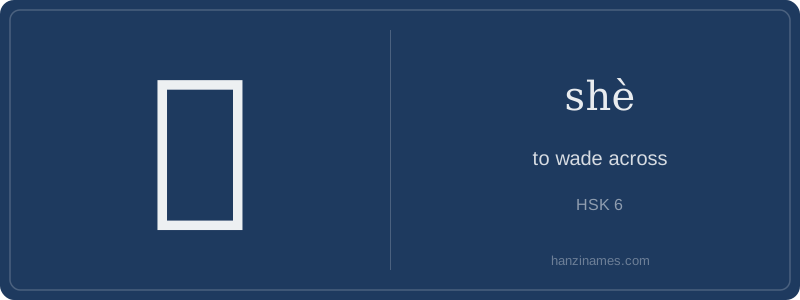
In contemporary China, 涉 is most commonly encountered in official, legal, and journalistic language—especially in phrases like 涉及 (shèjí, 'to involve/relate to') and 涉嫌 (shèxián, 'to be suspected of'). For example, news headlines frequently read: '某公司高管涉嫌贪污' ('A senior executive of a company is suspected of embezzlement'). The character also appears in the idiom 涉世未深 (shèshì wèishēn, 'inexperienced in worldly affairs'), reflecting its enduring link to 'entering' life’s complexities.
The character’s earliest attested form appears in bronze inscriptions of the Western Zhou dynasty (c. 1046–771 BCE), where it depicts a person stepping across flowing water—confirming its pictographic origin. The left side 氵 evolved from the full water radical 水, and the right side 步 was already a standardized representation of 'footsteps' by the Warring States period. No oracle bone form survives, but its bronze script ancestry is well-documented in sources like the *Jinwen Bian* (Bronze Script Dictionary).
Imagine standing at the edge of a shallow mountain stream in Guangxi’s karst countryside—water clear and cool, stones slick with moss. A farmer in rubber boots steps in, lifting his trousers, and begins to wade across. His legs move deliberately through the current, each step testing depth and stability. This physical act—crossing water on foot—is the original, concrete meaning of 涉 (shè). It captures intention, effort, and transition: not swimming, not boating, but walking *through* the water itself.
Over time, 涉 extended metaphorically to mean 'to enter into' or 'to be involved in' a situation, field, or matter—just as wading into water means entering its domain. In modern usage, it rarely refers to literal crossing; instead, it appears in formal or literary contexts: 'to involve oneself in politics', 'to touch upon sensitive topics', or 'to venture into new academic territory'. Its tone is deliberate, often cautious—even slightly solemn.
The radical 氵 (three-dot water) anchors its origin firmly in aquatic action, while the right side 步 (bù, 'step') visually reinforces motion and progression. Though simplified, this structure preserves the ancient logic: water + stepping = wading. At HSK Level 6, 涉 signals advanced lexical awareness—not just vocabulary, but an understanding of how Chinese builds abstract meaning from tangible, embodied experience.
Example Sentences
Common Compounds
Similar Characters — Don't Mix These Up
Your First Step into Chinese Culture: Get a Chinese Name
Every journey into Chinese begins with a name. Use our free Chinese name generator to create a meaningful, personalized Chinese name that fits you perfectly.
Get My Chinese Name →