涵
Character Story & Explanation
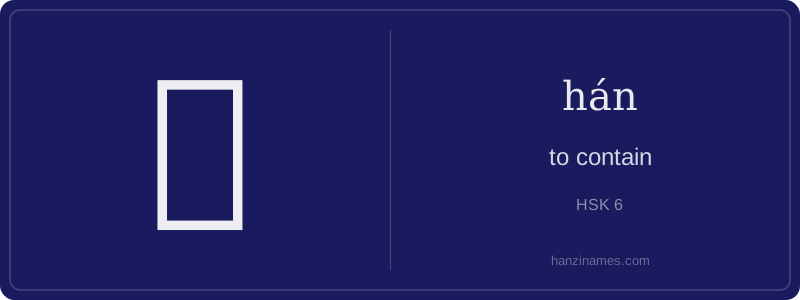
涵 is widely used in modern Chinese in formal, academic, and literary contexts—especially in phrases like 文化涵养 (wénhuà hán yǎng, 'cultural cultivation') and 内涵 (nèihán, 'connotation' or 'substance'). It appears in official discourse, education policy documents, and media analysis to denote depth, implicit meaning, or inclusive capacity. The term 内涵 is especially prominent: since the 2010s, it’s been repurposed online as slang ('inner meaning' → 'hidden truth' or ironic subtext), documented by China’s Language Resource Monitoring and Research Center.
The character’s form has no verified pictographic origin—it first appears in seal script (zhuànshū) as a clear phono-semantic compound: 氵+函. 函 itself was a pictograph of a box with a lid (甲骨文 variant showing a container with arrows), later stylized. So 涵’s visual logic is literal: water inside a sealed case — evoking saturation, retention, and quiet fullness.
As a linguistic detective, I begin at the scene: the character 涵 appears in early clerical script (lìshū) around the Han dynasty—not in oracle bones or bronze inscriptions—confirming its relatively late emergence. Its left side, 氵, is the water radical, signaling semantic connection to liquid, flow, or immersion; the right side, 函, is both phonetic (hán) and meaningful—originally a sealed box or case used to hold documents or arrows, symbolizing containment and protection.
The evolution reveals a conceptual layering: water + container = the idea of something being held within, submerged, or permeated. Unlike pictographs that directly mimic objects, 涵 is a phono-semantic compound built on metaphor—water doesn’t just fill space; it saturates, sustains, and envelops. This nuance explains why 涵 rarely means literal ‘containment’ like 包 (bāo), but rather implies depth, absorption, and implicit inclusion—think of water soaking into soil or culture seeping into identity.
By the Tang and Song dynasties, 涵 expanded into literary and philosophical registers: poets used it to describe how meaning ‘soaks into’ poetry (诗涵深意), and Neo-Confucians employed it for moral cultivation—virtue not imposed, but ‘absorbed’ over time. Its HSK 6 status reflects this abstract, context-sensitive usage: learners must grasp not just definition, but register, collocation, and cultural weight—much like English ‘imbue’ or ‘encompass’, which resist direct translation.
Example Sentences
Common Compounds
Similar Characters — Don't Mix These Up
Your First Step into Chinese Culture: Get a Chinese Name
Every journey into Chinese begins with a name. Use our free Chinese name generator to create a meaningful, personalized Chinese name that fits you perfectly.
Get My Chinese Name →