淆
Character Story & Explanation
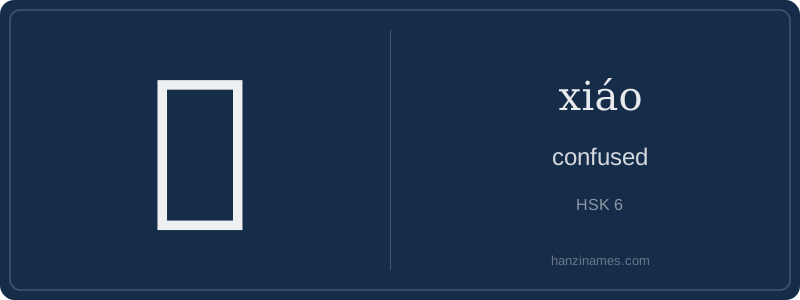
In modern Chinese, 淆 appears primarily in formal writing and set phrases—not daily speech. It’s indispensable in idioms like 混淆是非 (hùnxiáo shìfēi, 'to confuse right and wrong'), frequently cited in legal journalism and political commentary. The phrase appears in official Xinhua News Agency reports critiquing misinformation, and in academic ethics guidelines warning against data manipulation. Its usage is precise, high-register, and often polemical.
Historically, 淆 is not a pictograph or oracle-bone relic—it emerged later as a phono-semantic compound. Its left side 氵 clearly denotes water-related semantics (symbolizing flow, mixing), while 尧 provides pronunciation (xiáo, close to yáo). No pre-Qin inscriptions contain 淆; its earliest confirmed forms appear on Western Han bamboo slips from Mawangdui (2nd c. BCE), used in administrative inventories to flag mislabeled grain stores.
As an archaeologist sifting through layers of linguistic sediment, I uncover 淆 not as a static glyph but as a ripple in the water of meaning—its radical 氵 (water) anchoring it to fluidity and instability. The right component, 尧 (yáo), was originally a phonetic indicator borrowed from the legendary sage-king Yao, later repurposed for sound rather than sense. This fusion signals that confusion isn’t dry abstraction—it’s something that swirls, mixes, and resists separation, like muddy currents converging.
The character first appears reliably in Warring States bamboo texts and Han dynasty dictionaries like the Shuōwén Jiězì (121 CE), where Xu Shen defines it as ‘to mix up; to disturb the order’. Its early usage reflects bureaucratic anxiety: officials feared misclassifying documents or misassigning duties—hence 淆 carried moral weight, implying negligence or intellectual carelessness, not mere randomness.
Over centuries, 淆 evolved from concrete administrative error into a refined literary term for conceptual blurring—especially in classical essays and Neo-Confucian debates about distinguishing truth from illusion. Unlike colloquial words for ‘confused’ (e.g., 迷糊), 淆 retains a formal, almost forensic tone: it names the *process* of contamination—ideas bleeding into one another, categories collapsing—not just the resulting state.
Example Sentences
Common Compounds
Similar Characters — Don't Mix These Up
Your First Step into Chinese Culture: Get a Chinese Name
Every journey into Chinese begins with a name. Use our free Chinese name generator to create a meaningful, personalized Chinese name that fits you perfectly.
Get My Chinese Name →