渡
Character Story & Explanation
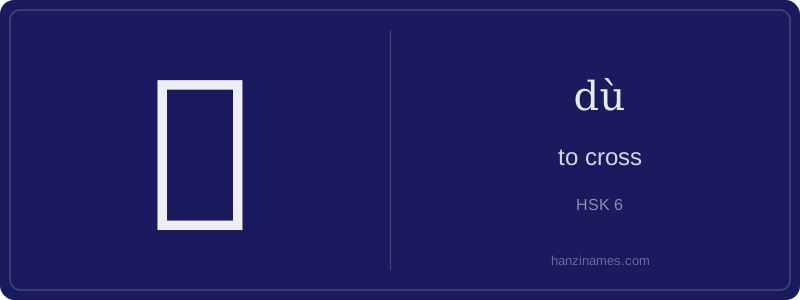
渡 is widely used in modern Chinese for regulated or formal crossings—especially water transport and administrative transitions. It appears in official terms like 出入境管理 (exit-entry administration), where 渡台 (dù tái) refers to legally crossing to Taiwan, and in historical narratives like 红军长征 (Long March), where Red Army troops famously 渡金沙江 (crossed the Jinsha River) in 1935—a documented, strategically pivotal crossing cited in Party historiography. The idiom 同舟共济 (tóng zhōu gòng jì) doesn’t contain 渡, but related phrases like 强渡大渡河 (qiǎng dù Dàdù Hé) commemorate the 1935 forced crossing of the Dadu River, taught in Chinese textbooks.
The character evolved from seal script (c. 3rd c. BCE), where it combined 氵 (water) and 度 (dù, 'to measure' or 'to pass'), indicating measured, deliberate passage across water. It was not pictographic but phono-semantic: 氵 signals meaning (water-related action), 度 provides pronunciation and conceptual nuance (‘measured crossing’). No oracle bone form exists—its earliest attestation is in Warring States bamboo slips, confirming its association with controlled, sanctioned transit.
The Chinese character 渡 (dù) conveys the core idea of crossing—especially over water—but extends metaphorically to transitions across time, states, or challenges. Unlike English 'cross', which is neutral and physical, 渡 carries solemnity and intentionality: it implies effort, passage through difficulty, or ritualized movement. Its water radical (氵) anchors it in aquatic crossings, yet its usage spans spiritual, historical, and bureaucratic domains—e.g., 'crossing' into a new era or 'crossing' a legal threshold.
In classical and modern Chinese, 渡 often appears in contexts requiring endurance or transformation: crossing rivers during wartime, crossing into enlightenment, or even crossing national borders legally. It rarely describes casual movement—it suggests gravity, consequence, and sometimes sacrifice. This weight contrasts sharply with Western equivalents like 'cross' (neutral), 'traverse' (technical), or 'pass' (often passive). 渡 is never light; it’s imbued with narrative significance.
Western cultural parallels include the River Styx in Greek myth—where Charon ferries souls across death’s boundary—or Christian baptismal 'crossing' as spiritual rebirth. But while those are symbolic thresholds, 渡 operates both literally (ferrying across the Yangtze) and bureaucratically (e.g., 渡口 'ferry terminal', 渡轮 'ferry'). Its duality reflects a Sino-centric worldview where geography, governance, and metaphysics intertwine—making it far more than a verb: it’s a civilizational marker of passage with purpose.
Example Sentences
Common Compounds
Similar Characters — Don't Mix These Up
Your First Step into Chinese Culture: Get a Chinese Name
Every journey into Chinese begins with a name. Use our free Chinese name generator to create a meaningful, personalized Chinese name that fits you perfectly.
Get My Chinese Name →