湖
Character Story & Explanation
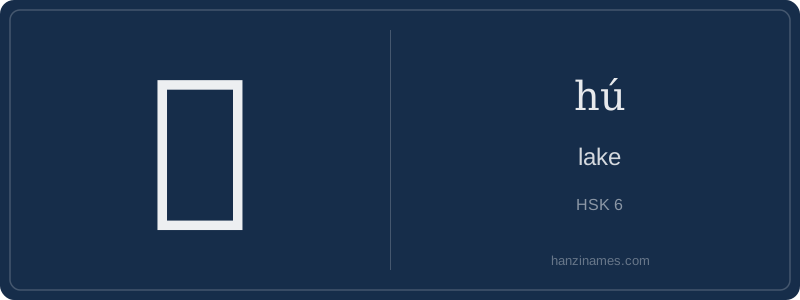
湖 is deeply embedded in Chinese geography and administration: provinces like Húnán (湖南, 'South of the Lake') and Húběi (湖北, 'North of the Lake') are named after Dongting Lake—a real, historically vital freshwater lake documented since the Warring States period (475–221 BCE). The character appears in over 200 official lake names, including West Lake (Xī Hú) in Hangzhou, a UNESCO World Heritage site since 2011. It’s also in idioms like 湖光山色 (hú guāng shān sè, 'lake light and mountain colors'), describing idyllic natural scenery.
The character 湖 is a latecomer—first appearing in seal script during the Qin dynasty (3rd c. BCE) as a phono-semantic compound. Its left side 氵 clearly signals 'water'; the right side 胡 was chosen purely for sound, not meaning. Unlike ancient pictographs (e.g., 日 for 'sun'), 湖 has no pictorial origin—it’s an invented character for a specific geographical concept, reflecting how Chinese writing evolved to name new environmental features.
Hi students! Let’s explore 湖 (hú), meaning 'lake'. It’s a Level 6 HSK character—so it appears in advanced vocabulary, but its structure is very logical. Notice the left part: 氵, the 'water' radical—it tells us this character relates to water bodies. The right side, 胡 (hú), is a phonetic component that hints at pronunciation. Even though 胡 originally meant 'beard' or 'non-Han people', here it’s borrowed just for sound. This is common in Chinese characters: one part gives meaning, another gives sound.
Writing 湖 takes exactly 12 strokes—practice them in order: three dots (氵) first, then the six strokes of 胡 (vertical, horizontal, vertical, dot, horizontal,捺). Don’t rush! Each stroke has direction and ending style. Think of it like drawing ripples on water: smooth, connected, and flowing. Beginners often mix up the dot placement in 胡—remember: the dot comes *before* the final sweeping stroke (捺), not after.
While 湖 means 'lake', it’s never used alone in daily speech—it always appears in compound words like 太湖 (Tài Hú, Lake Tai) or 湖南 (Húnán, 'South of the Lake', i.e., Hunan Province). That’s key: Chinese rarely uses single-character nouns alone. Also, 湖 is neutral in tone (hú, second tone)—not 'hǔ' or 'hù'. Try saying it while imagining calm water: “hú…” like a soft exhale over still lake surface.
Example Sentences
Common Compounds
Similar Characters — Don't Mix These Up
Your First Step into Chinese Culture: Get a Chinese Name
Every journey into Chinese begins with a name. Use our free Chinese name generator to create a meaningful, personalized Chinese name that fits you perfectly.
Get My Chinese Name →