沧
Character Story & Explanation
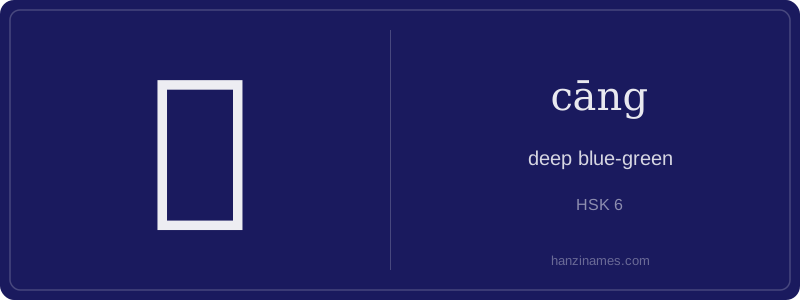
沧 is most famously used in the idiom 沧海桑田 (cānghǎi sāngtián), meaning 'the sea turns into mulberry fields'—a metaphor for immense, epochal change, first recorded in the 4th-century Daoist text Zhen Gao. It appears in Tang dynasty poetry (e.g., Li Bai’s lines on the Yellow River) and remains common in formal writing, news headlines about historical shifts, and environmental discourse about coastal erosion or climate change.
The character evolved from the older form 滄, with 氵 (water radical) and 苍 (cāng, 'grayish-blue; aged') as phonetic component. While not a pictograph, its structure is transparent: water + a phonetic that itself carries connotations of age and muted color—making it a rare case where sound and meaning reinforce each other historically.
沧 (cāng) evokes the profound, shifting hues of deep water—neither pure blue nor green, but a resonant blend suggesting depth, antiquity, and quiet power. Unlike Western color terms that prioritize spectral precision (e.g., 'cerulean' or 'teal'), 沧 carries poetic weight: it’s the color of ancient seas in classical poetry, not a paint-swatch descriptor. Its semantic field includes vastness, timelessness, and subtle transformation—think of mist over a fog-laced lake at dawn, not a Pantone code.
In Chinese aesthetics, 沧 is inseparable from philosophical resonance: it appears in Daoist and Chan Buddhist imagery to symbolize impermanence and depth of insight—like water that reflects yet never holds form. Compare this to Western equivalents: 'azure' connotes divine clarity (e.g., Byzantine mosaics), while 'indigo' suggests mysticism or colonial trade; 沧, by contrast, implies neither divinity nor commerce, but quiet, immersive profundity rooted in natural observation and literary tradition.
Culturally, 沧 rarely stands alone—it thrives in compounds like 沧海 (cānghǎi, 'vast sea') or 沧桑 (cāngsāng, 'changes over time'). This reflects a broader linguistic pattern: Chinese color-adjacent characters often function as evocative modifiers rather than standalone adjectives. In English, we might say 'the sea was deep blue'; in classical Chinese, one says 沧海浩渺 (cānghǎi hàomiǎo)—'the deep-blue-green sea stretches boundlessly'—where 沧 does the heavy lifting of mood, scale, and temporal gravity all at once.
Example Sentences
Common Compounds
Similar Characters — Don't Mix These Up
Your First Step into Chinese Culture: Get a Chinese Name
Every journey into Chinese begins with a name. Use our free Chinese name generator to create a meaningful, personalized Chinese name that fits you perfectly.
Get My Chinese Name →