滞
Character Story & Explanation
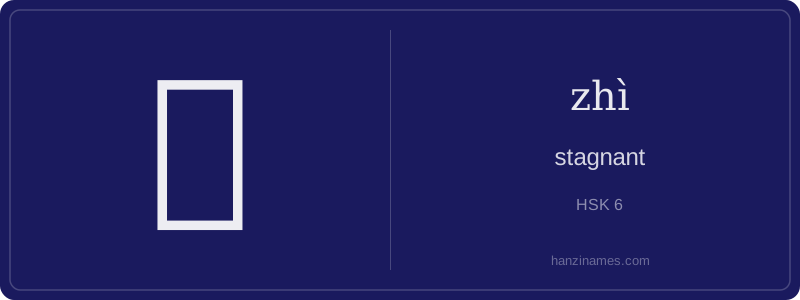
In contemporary China, 滞 appears frequently in official economic reports, medical diagnoses, and urban planning documents. Common phrases include '经济滞胀' (economic stagflation) and '气血不畅,易致气滞' (poor qi-blood circulation easily leads to stagnation)—a line cited in authoritative TCM textbooks like the Chinese Medicine Basic Theory (2021, People’s Medical Publishing House). It’s also central to idioms like '停滞不前' (to stagnate, make no progress), listed in the Contemporary Chinese Dictionary (7th ed., 2016).
The character’s form is phonosemantic: the left radical 氵 (water) signals association with fluidity or flow; the right component 帜 (zhì, originally meaning 'flag') serves primarily as a phonetic cue. Though 帜 itself evolved from 'banner', here it contributes sound—not meaning. No pictographic origin exists; its earliest attestation is in Han dynasty bamboo slips (c. 2nd century BCE), used consistently to denote obstruction in movement or circulation.
Imagine standing on a rain-slicked overpass in Shanghai at rush hour—the sky heavy, the air thick with humidity. Below, traffic crawls like syrup through a narrow bottle: cars inch forward, brake lights glow red for minutes, and exhaust hangs motionless in the damp air. This physical slowness—this resistance to flow—is the essence of 滞 (zhì). It’s not mere delay; it’s a systemic jam, where movement is choked by excess, imbalance, or obstruction.
In traditional Chinese medicine (TCM), 滞 describes pathological stagnation—qi or blood failing to circulate smoothly, leading to pain, emotional tension, or digestive discomfort. A TCM practitioner might diagnose 'liver qi stagnation' (肝气滞) after observing irritability and rib-side distension. Here, 滞 isn’t abstract—it’s felt in the body as tightness, heaviness, or dull ache, reflecting an ancient holistic view linking environment, emotion, and physiology.
Modern China uses 滞 critically in economic and technological discourse. When policymakers warn of 'capital flow stagnation' (资金滞留) or 'logistics bottlenecks' (物流滞缓), they invoke 滞 to signal systemic friction—not temporary delay, but structural inefficiency requiring intervention. The character thus bridges ancient bodily metaphors and 21st-century governance, always pointing to a condition where energy, money, or information *should* move but cannot.
Example Sentences
Common Compounds
Similar Characters — Don't Mix These Up
Your First Step into Chinese Culture: Get a Chinese Name
Every journey into Chinese begins with a name. Use our free Chinese name generator to create a meaningful, personalized Chinese name that fits you perfectly.
Get My Chinese Name →