浊
Character Story & Explanation
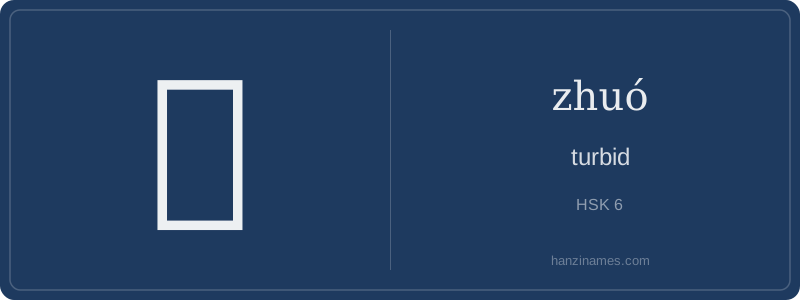
In modern Chinese, 浊 most commonly appears in technical and literary contexts: as part of scientific terms like 浊度 (zhuódù, 'turbidity') in environmental monitoring, or in classical idioms such as 清浊不分 (qīng zhuó bù fēn, 'unable to distinguish clear from turbid'), used since the Han dynasty to criticize moral confusion. It's also standard in linguistics: 浊音 (zhuóyīn) denotes 'voiced sounds'—a direct inheritance from ancient phonological classification in the Yunjing (12th c.) rhyme tables.
The character’s form has no verified pictographic origin; it emerged as a phono-semantic compound during the Warring States period. Today, Chinese students encounter it in HSK 6 reading passages about ecology or classical philosophy—and environmental agencies use it daily in water quality reports published by China’s Ministry of Ecology and Environment.
As an archaeologist sifting through layers of linguistic sediment, I find 浊 not in oracle bones—but in the bronze inscriptions of the Warring States period, where it first appears as a compound of 氵 (water) and 虫 (insect, later simplified to 壳-like phonetic element). Its early usage evokes water clouded by sediment or organic decay—less a scientific term than a visceral sensory judgment: water you wouldn’t drink, rivers choked with silt after floods, or ritual vessels rinsed but still murky. This wasn’t abstraction; it was ecological observation etched in bronze.
The character’s phonetic component, 虫 (chóng), is misleading today—it once served as a sound clue for *zhuó*, preserved in Middle Chinese rime dictionaries like the Qieyun (601 CE). Over centuries, the ‘insect’ shape evolved into a stylized ‘shell’-like form (the top-right strokes), while its semantic weight shifted from literal turbidity to metaphorical moral or aesthetic impurity—echoing Daoist critiques of ‘clouded’ minds and Confucian laments over ‘muddy’ governance.
In Tang poetry and Song Neo-Confucian texts, 浊 acquires philosophical gravity: Du Fu contrasts ‘clear’ (清) and ‘turbid’ (浊) qi to describe societal decay; Zhu Xi uses 浊气 (zhuóqì) to denote coarse, unrefined vital energy obstructing moral clarity. The character thus fossilizes a worldview where physical clarity mirrors ethical purity—a belief encoded so deeply that modern Mandarin still pairs 浊 with 音 (tone) to mean ‘voiced consonants’, preserving its ancient link between material density and perceptible resonance.
Example Sentences
Common Compounds
Similar Characters — Don't Mix These Up
Your First Step into Chinese Culture: Get a Chinese Name
Every journey into Chinese begins with a name. Use our free Chinese name generator to create a meaningful, personalized Chinese name that fits you perfectly.
Get My Chinese Name →