滥
Character Story & Explanation
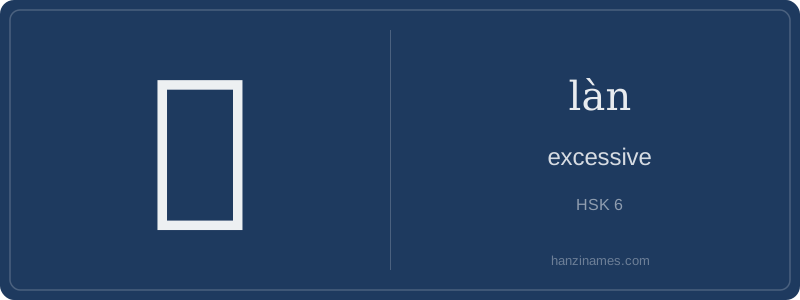
In modern usage, 滥 most commonly appears in negative compound words denoting excess, misuse, or lack of restraint—especially in formal or critical contexts. It features prominently in the idiom 滥竽充数 (làn yú chōng shù), documented since the Warring States period, meaning 'to pass off as competent without real skill' (literally: 'pass off poor yu-playing as part of the ensemble'). Government reports and media frequently use 滥用 (lànyòng, 'misuse')—e.g., 滥用职权 ('abuse of power'), a legally defined offense under China’s Criminal Law.
The character’s form is not pictographic but phono-semantic: the left radical 氵 clearly signals water-related meaning, while the right component 監 (jiān) serves both phonetic and semantic roles—its original meaning 'to supervise water' reinforces the idea of failing to monitor limits. No oracle bone or bronze script forms of 滥 survive; its earliest verified appearance is in late Warring States bamboo manuscripts.
As an archaeologist sifting through layers of linguistic sediment, I uncover 滥 not as a simple 'overflowing'—but as a hydraulic metaphor fossilized in script. Its water radical (氵) anchors it to ancient flood narratives and irrigation crises; the right side, 監 (jiān), originally depicted a person observing water in a basin—suggesting surveillance of excess. This duality reveals early Chinese statecraft: controlling water meant controlling chaos, and 滥 emerged where regulation failed.
The character’s earliest secure attestation appears in Warring States bamboo texts (c. 475–221 BCE), where it describes unregulated use of resources—timber, grain, or labor—not just literal floods. It carries moral weight: overflow isn’t neutral; it signals negligence, greed, or systemic breakdown. Unlike generic terms for 'much', 滥 implies *unjustified* abundance, a breach of balance codified in Confucian and Legalist administrative records.
By the Han dynasty, 滥 had crystallized into a lexical marker of ethical overreach: ‘滥赏’ (indiscriminate rewards), ‘滥刑’ (excessive punishment). Its thirteen strokes map a cultural anxiety—water as life-giver and destroyer—and its persistence into modern Mandarin confirms how deeply hydrological metaphors shape Chinese moral reasoning. To write 滥 is to inscribe a millennia-old warning: abundance without restraint invites collapse.
Example Sentences
Common Compounds
Similar Characters — Don't Mix These Up
Your First Step into Chinese Culture: Get a Chinese Name
Every journey into Chinese begins with a name. Use our free Chinese name generator to create a meaningful, personalized Chinese name that fits you perfectly.
Get My Chinese Name →