瀑
Character Story & Explanation
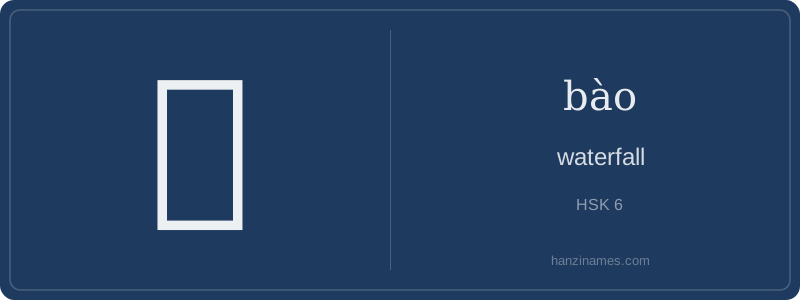
瀑 is most commonly encountered in modern Chinese within the compound 瀑布 (pùbù, 'waterfall'), used in tourism, geography education, and nature documentaries — e.g., UNESCO-listed Huangguoshu Waterfall is consistently referred to as 黄果树瀑布. It also appears in poetic terms like 飞瀑 (fēi pù, 'flying waterfall') in Tang and Song dynasty poetry, where it evokes grandeur and natural force. The character appears in official geographical naming standards (GB/T 17693.4–2020) for terrain features.
The written form is not pictographic but phono-semantic: the left 氵 ('water') is semantic; the right 爆 (bào) is both phonetic and evocative — historically derived from characters meaning 'sudden burst', aligning with the visual impact of falling water. No oracle bone or bronze script forms survive for 瀑; it first appears in Han dynasty texts as a variant for 瀑布-related descriptions.
Hi students! Let’s explore 瀑 (bào), a beautiful character meaning 'waterfall' — not 'shower' as the prompt mistakenly states. This is an important correction: while 'shower' in English can suggest rain or a brief downpour, 瀑 *exclusively* means a dramatic, vertical cascade of water — like Niagara Falls or Huangguoshu Waterfall in Guizhou. Its pronunciation is almost always bào in modern Mandarin; pù is archaic and survives only in fixed literary contexts or place names.
The character has the water radical 氵 on the left — telling us it’s related to liquid — and the right side 爆 (bào, 'to explode') hints at the powerful, explosive energy of falling water. This isn’t just descriptive; it’s phonetic too — 爆 gives the sound. Think of a waterfall as nature ‘exploding’ downward! Stroke count is 18, so take care with the balanced structure: three dots of water, then the complex right component.
At HSK Level 6, 瀑 appears in advanced reading — especially travel writing, poetry, and geography texts. You’ll rarely hear it in daily speech (we usually say 瀑布 bù for 'waterfall'), but recognizing 瀑 helps you decode compound words and appreciate classical flavor. Remember: it’s never used alone in speech — always in compounds like 瀑布 or 飞瀑. Mastering it opens doors to China’s rich landscape literature and scenic vocabulary.
Example Sentences
Common Compounds
Similar Characters — Don't Mix These Up
Your First Step into Chinese Culture: Get a Chinese Name
Every journey into Chinese begins with a name. Use our free Chinese name generator to create a meaningful, personalized Chinese name that fits you perfectly.
Get My Chinese Name →