灶
Character Story & Explanation
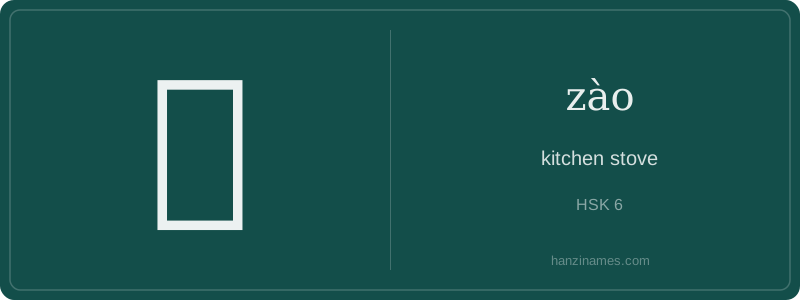
In daily life, 灶 appears in modern contexts like 燃气灶 (ránqì zào, gas stove) and in folk rituals such as the annual Zao Shen sacrifice on the 23rd day of the 12th lunar month—a documented tradition recorded in Ming-Qing dynasty almanacs and still observed across rural and urban China. It features in idioms like ‘灶王爷上天言好事’ (The Kitchen God ascends to heaven to speak good things), reinforcing its role as household moral witness.
The character evolved from seal script (c. 3rd century BCE), where it clearly depicted a raised hearth with flames above and a base below—confirming its origin as a stylized pictograph of a brick or clay stove used for cooking and heating. No oracle bone form survives, but bronze inscriptions and early dictionaries like the Shuōwén Jiězì (100 CE) define it explicitly as ‘the place where fire is made for cooking’.
The character 灶 (zào) embodies the ancient Chinese reverence for the hearth—not merely as a cooking appliance, but as a sacred domestic altar. In traditional cosmology, the stove is the domain of the Kitchen God (Zao Shen), who observes family conduct and reports to heaven annually. This spiritual dimension transforms the physical stove into a moral compass embedded in daily life, reflecting how material objects in Chinese thought often serve as vessels for ethical and cosmic meaning.
Its radical 火 (fire) anchors it in elemental philosophy: fire represents transformation, vitality, and purification—qualities essential to both cooking and spiritual renewal. The seven-stroke structure balances simplicity with symbolic weight; every stroke contributes to a compact yet potent ideograph that unites utility, ritual, and ancestral continuity. Unlike Western stoves seen as tools, 灶 signifies relational harmony—between humans and deities, generations, and nature.
This worldview sees domestic space as microcosmic: the kitchen stove is where grain becomes nourishment, where families gather, where secrets are whispered, and where virtue is quietly cultivated. Even today, elders may still ‘send off’ the Kitchen God before Lunar New Year with sticky candy—a practice rooted in the belief that sweetness softens divine judgment. Thus, 灶 is not just a word—it’s a cultural node linking food, faith, and filial responsibility in one quiet flame.
Example Sentences
Common Compounds
Similar Characters — Don't Mix These Up
Your First Step into Chinese Culture: Get a Chinese Name
Every journey into Chinese begins with a name. Use our free Chinese name generator to create a meaningful, personalized Chinese name that fits you perfectly.
Get My Chinese Name →