炎
Character Story & Explanation
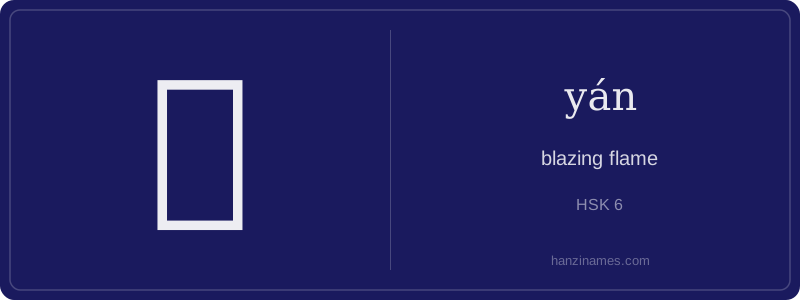
In modern Chinese, 炎 appears most frequently in compound words related to inflammation (e.g., 扁桃体炎 biǎntáotǐ yán ‘tonsillitis’) and cultural-historical terms like 炎黄子孙 Yán Huáng zǐsūn ‘descendants of Yan and Huang’, referencing the legendary Flame Emperor (Yan Di) and Yellow Emperor. It’s central to national identity rhetoric and medical terminology — appearing over 1,200 times in the 2020 edition of the Chinese Medical Terminology Standard.
The character’s origin is documented in Xu Shen’s Shuōwén Jiězì: ‘炎, fire ascending’ (火光上也). It’s a clear ideograph — two 火 stacked to convey intensified flame — with no phonetic element. No oracle bone or bronze script variants are confirmed; its earliest secure form is seal script (c. 3rd century BCE), already showing the doubled-fire structure.
As a detective tracing 炎’s evolution, I begin at the oracle bone and bronze inscriptions — but here’s the twist: no verified oracle bone form of 炎 survives. The earliest attested form appears in Warring States bamboo texts and the Shuōwén Jiězì (121 CE), where Xu Shen explicitly defines it as ‘flame rising high’ — not just fire, but intense, doubled combustion. Its structure is unmistakably semantic: two stacked 火 (fire) radicals, visually amplifying heat and energy.
This doubling isn’t poetic license — it’s functional intensification, a common morphographic strategy in early Chinese. Unlike single-fire characters like 火 or 灯 (lamp), 炎 signals extremity: scorching heat, blazing prominence, or inflamed condition. Linguistically, it anchors words where intensity matters — not ambient warmth, but overwhelming, active combustion. Its phonetic component? None. It’s a pure ideograph: meaning built entirely from visual repetition.
By the Han dynasty, 炎 had stabilized into its modern 8-stroke form — two identical 火 units, each with four strokes (点、短撇、长撇、捺), stacked symmetrically. Calligraphers note the upper fire’s捺 must be slightly shorter than the lower’s to avoid visual crowding — a subtle but critical balance reflecting ancient attention to structural harmony. This isn’t mere writing; it’s embodied thermodynamics in ink.
Example Sentences
Common Compounds
Similar Characters — Don't Mix These Up
Your First Step into Chinese Culture: Get a Chinese Name
Every journey into Chinese begins with a name. Use our free Chinese name generator to create a meaningful, personalized Chinese name that fits you perfectly.
Get My Chinese Name →