焦
Character Story & Explanation
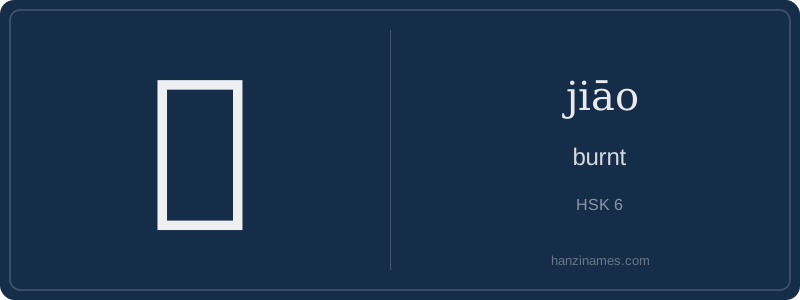
In modern China, 焦 is ubiquitous in food culture and mental health discourse. Roasted chestnuts sold on winter streets are labeled 糖炒栗子 (táng chǎo lìzi), and vendors warn customers against overly 焦 ones—bitter, hard, and smoky. The HSK-6 idiom 焦头烂额 appears in official media describing bureaucratic overload, while 焦虑 (jiāo lǜ) is the standard term for 'anxiety' in clinical psychology and public health campaigns since the 2010s.
The character’s form derives from seal script: the bottom 灬 clearly represents fire; the top 雔 is a phonetic component borrowed from 雀 (què, 'sparrow'), indicating pronunciation, not meaning. No oracle bone or bronze inscription evidence exists for 焦—it first appears reliably in Han dynasty texts, consistently tied to burning and agitation.
The character 焦 (jiāo) evokes the sharp, acrid scent of over-roasted coffee beans in a Beijing café—where baristas pause mid-pour to sniff the grounds and murmur, 'Too 焦!' It originally conveyed the visual and sensory reality of charring: blackened edges, cracked surfaces, and heat-induced transformation. In classical texts like the Shuōwén Jiězì (121 CE), it was defined as 'burnt to blackness', linking physical scorching to metaphorical states like anxiety—where the mind feels 'overheated' and brittle.
Today, 焦 extends far beyond literal burning. It anchors idioms like 焦头烂额 (jiāo tóu làn é, 'scorched head,烂额'—utterly overwhelmed) and compounds like 焦虑 (jiāo lǜ, 'anxiety'), where psychological tension mirrors the irreversible damage of fire. This semantic expansion reflects a core Chinese linguistic pattern: concrete physical experiences become metaphors for inner states—heat becomes stress, blackening becomes exhaustion.
Its radical 灬 (four dots, a variant of 火 'fire') anchors its meaning in combustion, while the upper component 雔 (a rare variant of 雀, 'sparrow') hints at historical phonetic borrowing—not pictographic origin, but sound-based derivation. Though not visually fire-like, the four-dot radical instantly signals thermal or transformative energy, making 焦 instantly recognizable in compound words related to roasting, distress, or intensity.
Example Sentences
Common Compounds
Similar Characters — Don't Mix These Up
Your First Step into Chinese Culture: Get a Chinese Name
Every journey into Chinese begins with a name. Use our free Chinese name generator to create a meaningful, personalized Chinese name that fits you perfectly.
Get My Chinese Name →