烛
Character Story & Explanation
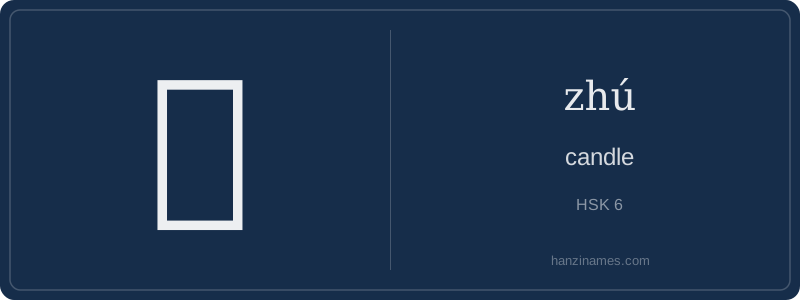
In modern Chinese life, 烛 appears most frequently in ceremonial and literary contexts—not daily utility. It’s central to the idiom ‘洞若观烛’ (dòng ruò guān zhú), meaning ‘as clear as viewing something by candlelight’, attesting to its enduring metaphor for insight. Historically, candlelight was critical in pre-electric scholarly life: the phrase ‘囊萤映雪’ (fireflies in a bag, snow reflection) and ‘凿壁偷光’ (boring a hole to borrow light) highlight how precious artificial light was—making 烛 a symbol of diligence and enlightenment.
The character’s seal script form (c. 4th century BCE) clearly depicts a flame (火) atop a vessel holding wax or oil—confirmed by excavated Warring States bronze candle holders from Henan. No pictographic sun/moon/tree association exists; its origin is purely functional: fire + container. Today, it’s used almost exclusively in set phrases, poetry, and traditional rites—not for LED candles or birthday cakes (which use 蜡烛, not just 烛).
As an archaeologist sifting through Han dynasty bamboo slips and Tang stele inscriptions, I found 烛 not as a mere object—but as a luminous cultural artifact. Its earliest secure attestations (c. 2nd century BCE) appear in medical texts like the *Mawangdui Silk Manuscripts*, where candlelight symbolized diagnostic clarity: physicians examined patients ‘by candlelight’ (烛下) to observe subtle complexion changes—a practice documented in the *Huangdi Neijing*. The character’s fire radical (火) anchors it in material reality: wax, wick, flame.
Excavations at Dunhuang’s Library Cave revealed 9th-century Buddhist sutra colophons noting ‘candles offered for merit’—proving 烛 was ritually standardized long before poetic metaphors emerged. Unlike later literary uses (e.g., Li Shangyin’s ‘spring蚕 to death silk unbroken, candle tears dry when ashes cold’), early usage was functional: timekeeping (candle clocks), ritual lighting, and medicinal illumination. No oracle bone or bronze script forms survive—its earliest form is seal script from the Warring States period, already compound and stable.
This character resisted simplification: both PRC and ROC standards retain the original 10-stroke form. Its endurance reflects its semantic precision—never conflated with lanterns (灯) or oil lamps (灯). In Song legal codes, ‘candle tax’ (烛课) was levied on wax producers, revealing its economic weight. Even today, when Chinese families light candles at Qingming, they enact a 2,200-year-old continuity: not superstition, but embodied memory encoded in ink, flame, and stroke.
Example Sentences
Common Compounds
Similar Characters — Don't Mix These Up
Your First Step into Chinese Culture: Get a Chinese Name
Every journey into Chinese begins with a name. Use our free Chinese name generator to create a meaningful, personalized Chinese name that fits you perfectly.
Get My Chinese Name →