炉
Character Story & Explanation
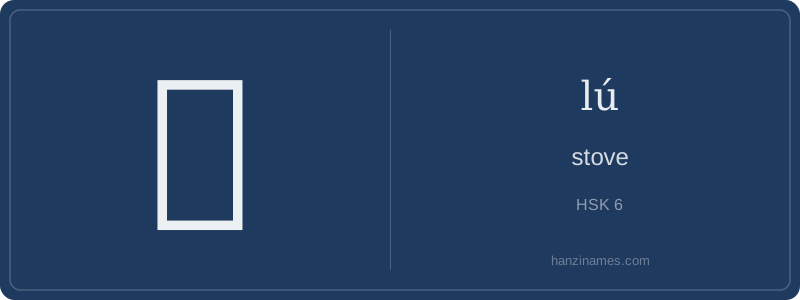
炉 is widely used today in both literal and figurative senses: as part of common nouns like 煤气炉 (méiqìlú, 'gas stove'), 电炉 (diànlú, 'electric stove'), and in idioms like 炉火纯青 (lú huǒ chún qīng), denoting consummate skill. It appears frequently in safety signage ('No open flame'), cooking instructions, and industrial documentation across China, Taiwan, and Singapore. Historical records from the Song-era *Tiangong Kaiwu* (1637) detail charcoal-fired 炉 for iron smelting and porcelain kilns, confirming its longstanding technical role.
The character evolved from seal script, where the left side was clearly 火 (fire), and the right side 尸 (shī) — not 'corpse', but an ancient phonetic component derived from a pictograph of a seated person, later standardized as a phonetic indicator for lú. No oracle bone form survives; its earliest attested use is in Warring States bamboo slips (4th c. BCE), showing consistent structure with fire radical and phonetic element.
The Chinese character 炉 (lú) means 'stove' or 'furnace' and belongs to the fire radical (火), reflecting its fundamental association with heat, combustion, and controlled fire. With just eight strokes, it is a compact yet semantically rich character used across domestic, industrial, and metaphorical contexts — from kitchen stoves to blast furnaces and even symbolic 'crucibles' of transformation.
In contrast to Western stoves — often integrated appliances (e.g., gas ranges or electric ovens) emphasizing convenience and precision temperature control — traditional Chinese 炉 evokes portable, multifunctional units like the brazier (炭炉 tànlú) for heating or hotpot, or the ceramic or cast-iron 'wok stoves' designed specifically for high-heat stir-frying. This reflects deeper cultural priorities: adaptability, fuel efficiency (charcoal, coal, or biomass), and integration into communal dining rituals.
Historically, 炉 appears in Tang and Song dynasty texts describing metallurgical furnaces and Daoist alchemical equipment, later evolving into household terms like 炉子 (lúzi, 'stove') and idioms such as 炉火纯青 (lú huǒ chún qīng), meaning 'mastery perfected' — literally 'the stove-fire turns pure blue', referencing the precise flame color indicating optimal temperature in bronze casting. This metaphor underscores how deeply material technology shaped Chinese philosophical and linguistic expression.
Example Sentences
Common Compounds
Similar Characters — Don't Mix These Up
Your First Step into Chinese Culture: Get a Chinese Name
Every journey into Chinese begins with a name. Use our free Chinese name generator to create a meaningful, personalized Chinese name that fits you perfectly.
Get My Chinese Name →