牲
Character Story & Explanation
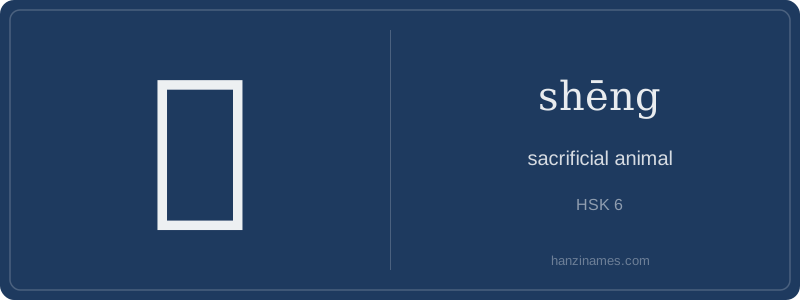
In classical Chinese texts and formal writing, 牲 appears almost exclusively in ritual, historical, or literary contexts—never in casual conversation. It’s found in canonical works like the Classic of Filial Piety (《孝经》) and modern academic discourse on ancient rites. Common compounds include 牺牲 (xīshēng, 'sacrifice') and 牲畜 (shēngchù, 'domestic animals'), the latter used in agricultural policy documents and veterinary science textbooks since the 1950s.
The character evolved from a bronze script pictograph showing an ox with prominent horns and a tied rope—clearly indicating a ritually prepared animal. By the Han dynasty, the ‘shēng’ (生) component was standardized on the right, reflecting phonetic borrowing while preserving semantic gravity. No oracle bone form is definitively identified as 牲, but its earliest secure attestations are on Western Zhou bronzes circa 10th century BCE.
As an archaeologist brushing dust from a Warring States bamboo slip, I find 牲 etched not as a generic 'animal', but as a ritual actor—sacrificial cattle bound for ancestral altars. Its ox-radical (牛) grounds it in agrarian reality: the beast was wealth, labor, and sacred offering rolled into one. Early texts like the Book of Rites specify that only unblemished 牲—oxen, sheep, or pigs—could mediate between human and divine. This wasn’t livestock; it was liturgy made flesh.
The character’s nine strokes encode layered meaning: the left ‘ox’ radical signals species and status; the right ‘shēng’ (生) component—originally depicting sprouting plants—here implies *life offered*, not just life raised. In oracle bone inscriptions, 牲 appears alongside divination records: 'Crack-making on day x: will the 牲 be accepted by Ancestor Yi?' The stroke count (9) mirrors ritual precision—nine being a sacred number in Zhou cosmology, marking completeness in sacrifice.
Unearthing bronze inscriptions from the Western Zhou, I see 牲 carved beside ritual vessels like the ding cauldron—proof that this character anchored state theology. It wasn’t merely lexical; it was performative. To write 牲 was to invoke obligation: to rear, select, purify, and present. Even today, its HSK-6 rarity reflects how deeply it’s embedded in classical grammar and ceremonial vocabulary—not daily speech, but textual bedrock. Its survival testifies to how language preserves ritual memory long after the altars crumble.
Example Sentences
Common Compounds
Similar Characters — Don't Mix These Up
Your First Step into Chinese Culture: Get a Chinese Name
Every journey into Chinese begins with a name. Use our free Chinese name generator to create a meaningful, personalized Chinese name that fits you perfectly.
Get My Chinese Name →